Comments on an Augmented Lagrangian Approach to Stellarator Coil Design
These are my thoughts on the paper: Pedro F. Gil, Weiping Li, Julianne Stratton, Alan A. Kaptanoglu and Eve V. Stenson's Stellarator Coils for Future Fusion Reactors via an Augmented Lagrangian Approach (Phys. Rev. Lett. 137, 065101, 2026), which takes the coil-design of stellarator engineering, a step that has historically forced designers to tune ten or more numerical weights, and reformulates it as a constrained optimisation problem.
Why coil design is the bottleneck
A stellarator confines plasma with a three-dimensional magnetic field shaped by external coils, not by a current driven through the plasma as in a tokamak. That ensures steady-state operation and sidesteps the disruption events that plague tokamaks, but it pushes all of the design difficulty onto the coils. The paper frames stellarator design as two problems: stage I finds a plasma equilibrium with good confinement properties, and stage II finds a set of coils whose field is everywhere tangential to that equilibrium's boundary. Stage II is the one this Letter is about, and it is an ill-posed inverse problem: any single equilibrium means infinitely many coil sets that reproduce it, and almost all of them are impossible to build.
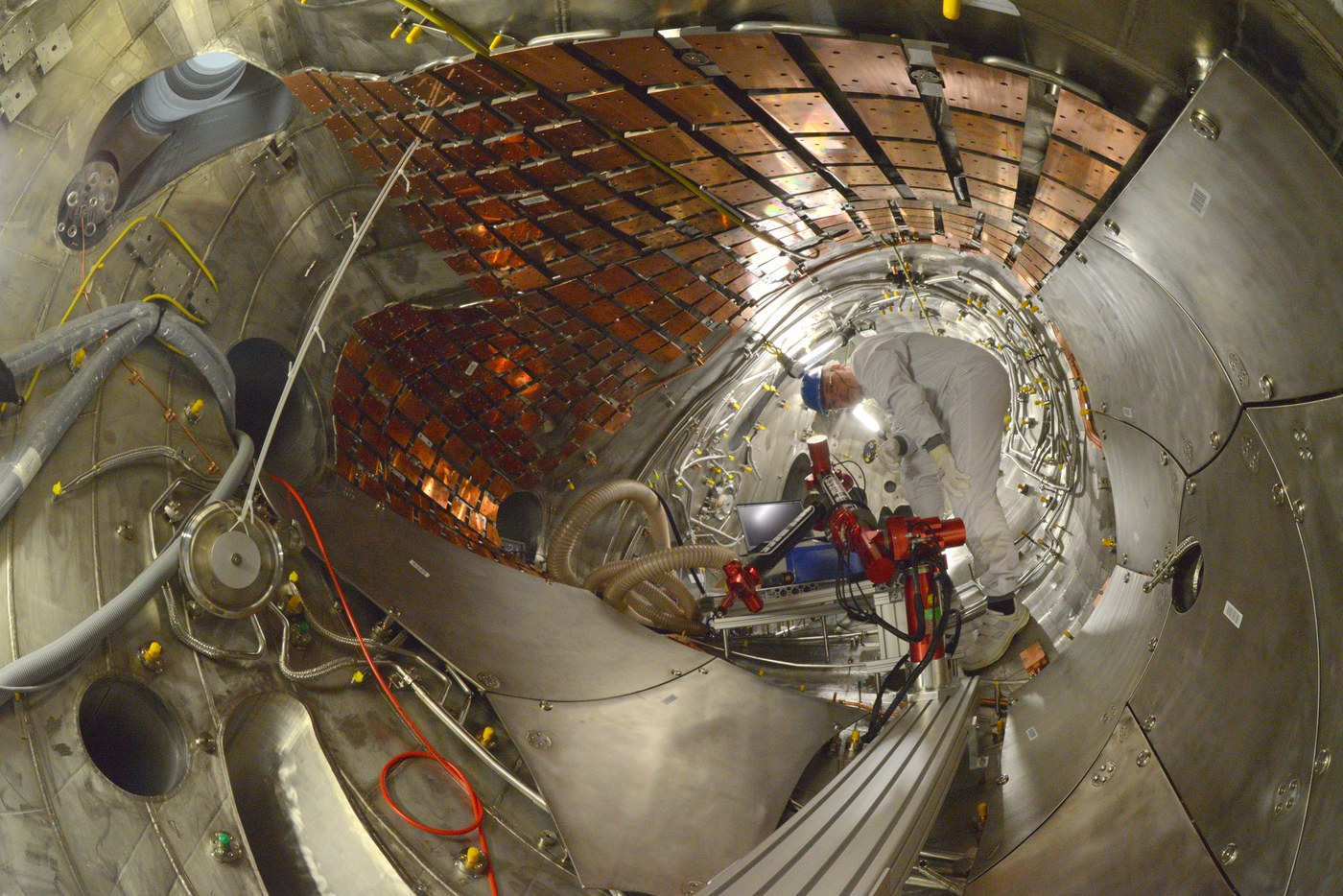
Coil complexity is named as a factor in the cancellation of the NCSX project and in the decade-long construction of the Wendelstein 7-X magnets pictured above. Coil design may be the most important scientific bottleneck in providing vast amounts of inexpensive energy to the world at large: its importance cannot be understated.
The old way
Current state-of-the-art coil optimisation requires every engineering requirement, coil-to-coil spacing, curvature limits, total length, force on the conductor, into a single scalar objective as a weighted sum, typically with ten to fifteen weights that a user has to set by hand. The paper's baseline comparison, taken from Kaptanoglu et al.'s earlier scan, ran 8500 separate optimisations with randomly assigned weights to map out what the achievable trade-offs looked like. This is why a new method is needed: not because the weighted-sum method cannot find good coils, but that finding them requires a huge search over hyperparameters that have no principled a priori value, which is slow and offers no guarantee that the region actually explored contains the best available trade-offs.
Reformatting the problem as an augmented Lagrangian
The paper's fix is to stop treating the engineering requirements as weighted terms and instead treat them as hard equality constraints, handled with an augmented Lagrangian:
\[ \mathcal{L}_A(x, \lambda, \mu) = f(x) - \lambda^\top c(x) + \frac{1}{2} \left\| \sqrt{\mu} \circ c(x) \right\|_2^2 \]
where \( c(x) \) is the vector of constraints, \( \lambda \) is a vector of Lagrange multipliers, and \( \mu \) is a vector of penalty parameters. The important move is that what used to be a hand-set weight is now one of two automatically updated quantities, either a Lagrange multiplier or a penalty parameter, each with its own update rule. Inequality constraints (a curvature that must stay below some threshold) are included in by taking the constraint as \( \max(c_l(x) - c_{\text{target}}, 0) = 0 \).
Demoting the objective
The classic objective for coil design is the squared flux metric,
\[ f_{\text{SF}} = \frac{1}{2} \frac{\int_S |\mathbf{B} \cdot \mathbf{n}|^2 \, dS}{\int_S |\mathbf{B}|^2 \, dS} \]
a measure of how far the coils' field departs from the target equilibrium's boundary. Traditionally this is what gets minimised, with everything else added as penalty terms around it. The authors instead moves \( f_{\text{SF}} \) into \( c(x) \) as an inequality constraint with an upper threshold, and replace the objective function \( f(x) \) with a dummy that is always zero and always returns a zero gradient.
Two configurations
The Letter demonstrates the method on two plasma shapes. The first is a quasi-axisymmetric (QA) equilibrium from Landreman and Paul, important as sufficiently good quasisymmetry lets a stellarator reach neoclassical transport levels comparable to a tokamak, which is important for confining the fusion-born α-particles a reactor needs to reheat its plasma. Scaled to the ARIES-CS reactor's 5.7 T on-axis field and 1.7 m minor radius, the paper's 12-coil solution is compared against a published 16-coil design by Wechsung et al. at equal total coil length. The 12-coil result wins on field accuracy, on maximum conductor force, and on quasisymmetry error, while using fewer coils and leaving more space between them.
It does not win on everything, and the paper says so: because fewer coils means higher current per coil to hold the same average field, the 12-coil design needs 194 km of high-temperature superconducting (HTS) tape against the 16-coil design's 146 km. The Wechsung comparison wins on minimum coil-to-surface distance and on maximum curvature, by small margins.
The Stellaris comparison
The second demonstration targets a quasi-isodynamic (QI) equilibrium, compared against Stellaris, the coil set published by the private fusion company Proxima Fusion for a 12.7 m major radius, 9 T, roughly 2700 MW power plant design. The paper reports two of its own configurations against Proxima's baseline, one (no. 1) tuned to improve physics accuracy, the other (no. 2) tuned to improve the engineering metrics across the board.
| Property | No. 1 | No. 2 | Proxima |
|---|---|---|---|
| Max force [MN/m] | 0.64 | 0.64 | 0.9 |
| Min coil-to-coil distance [m] | 0.7 | 0.89 | 0.67 |
| Max curvature κ [m−1] | 1.6 | 0.96 | 1.57 |
| HTS length [km] | 232 | 208 | 221 |
Configuration no. 2 reduces the maximum conductor force by 29% and the required HTS length by 6% relative to Proxima's design, while increasing the minimum coil-to-coil spacing by 22 cm and cutting the maximum curvature by 39%, all at a comparable coil length. Configuration no. 1, run with the opposite priority, improves the maximum field-error metric by 54% by allowing the coils more length. Between the two, the paper is making a point about the method rather than about either configuration specifically: the same augmented Lagrangian method can trade physics accuracy against manufacturability in either direction, on demand, without anyone going back to re-tune a weight vector by hand.
Problems the method inccurs
Two limitations are stated. First, every result here is an "unperturbed" configuration: the coils are optimised against a mathematically exact target field, and it remains unknown whether reactor-scale manufacturing and assembly tolerances will let a built coil set actually reach the field errors these numbers report. Given that the introduction opens by blaming coil complexity for real cost overruns and construction delays, this is the gap that would need to close before any of these numbers move into a procurement decision. Second, all of the quasisymmetry and quasi-isodynamic error figures are single-number summaries of a field property that varies continuously over the plasma surface, so two configurations with similar headline numbers could still differ in how that error is distributed.
Neither point undermines the central claim, which is narrower and, on the evidence given, well supported. That the whole comparison, all 8500 baseline runs included, was reproducible on a single laptop using the open-source SIMSOPT code is also worth noting, since it is a hugely low barrier to entry for an area of research that has historically needed a great deal of dedicated computing time to explore.
References
Gil, P. F., Li, W., Stratton, J., Kaptanoglu, A. A., & Stenson, E. V. (2026). Stellarator coils for future fusion reactors via an augmented Lagrangian approach. Physical Review Letters, 137, 065101. doi.org/10.1103/n7gk-922h.
Gil, P. F., Li, W., Stratton, J., Kaptanoglu, A. A., & Stenson, E. V. (2026). Augmented Lagrangian methods produce cutting-edge magnetic coils for stellarator fusion reactors (companion paper). Physical Review E, 114, 025202.
Discussion