The Ontology of Space and Time
What kind of thing is space? What kind of thing is time? The answer is that most of us go through life using both words without ever having to confront the question, because nothing in ordinary life begs the issue. Physics and philosophy do force it, however, and the answer determines a great deal else: whether the universe has a single "now," whether space is a container that would still be there if you removed everything in it, and whether the concepts of space and time describe the world or are contributed by the mind that perceives it. This piece works through three historically influential answers to that question, Newton's, Kant's, and the relational tradition running from Aristotle through Leibniz, including the version developed by Leonard Peikoff, and what each one commits you to once general relativity and current quantum gravity research are brought into it.
Two rival pictures
Historically there are two answers to what space and time are, prior to the relational tradition which this piece spends most of its time on.
The first is Newtonian absolutism: the view that space and time are themselves substances, existing independently of whatever objects happen to occupy them. On this view, if you annihilated every physical object in the universe, empty space would still be there — a container persisting with its own structure, waiting to be filled again. Newton needed something like this to make sense of absolute acceleration (his bucket argument is the classic case: spin a bucket of water, and the water climbs the sides even with nothing external to measure the rotation against, which Newton took as evidence that rotation is rotation relative to space itself, not merely relative to other bodies). Leibniz, arguing against Newton's defender Samuel Clarke, took the opposite position: space is nothing but the order of coexisting things, and time nothing but the order of successive things. Take away the things, and there is no space or time left over for them to have been "in." This is the relational tradition, and it goes back further than Leibniz — Aristotle had already defined time as "the number of motion in respect of before and after," which is a relational definition through and through: time is not a thing alongside motion, it is a measure of motion. Lucretius, writing a few centuries after Aristotle, makes essentially the same point about time even more directly: "Time also exists not by itself, but simply from things themselves comes a feeling for what has already taken place, what is now going on, and what is going to happen later; it must not be claimed that anyone can sense time by itself, apart from the motion or restful stillness of things" (De Rerum Natura, Book I). Time, on this reading, is not one more item in the universe alongside atoms and void; it is nothing over and above the relations among the motions of things, which is the relational thesis stated as plainly as antiquity ever states it.
The second way of going wrong is Kant's: space and time are neither substances nor relations among external things, but forms of intuition that the perceiving mind imposes on whatever it experiences, prior to and independent of experience itself. On this view we can never know whether space and time characterise reality as it is in itself, because space and time are precisely the lens through which any experience must pass to become experience at all. This is a genuinely different kind of move from either Newton's or Leibniz's: it does not locate space and time in the world, in things or their relations, but in the constitution of the subject.
A relational alternative
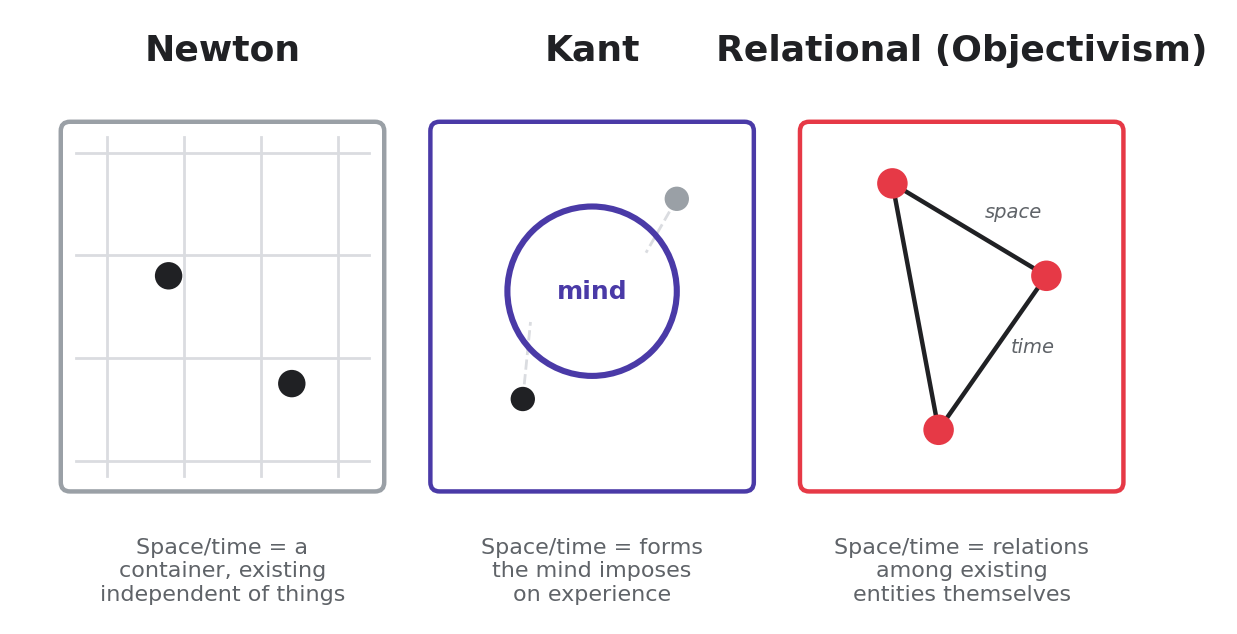
The Objectivist position, as Peikoff presents it, sides with the relational tradition against Newton, and sides with realism against Kant — and the second move is at least as important as the first, because it is easy to hear "space and time are relational, not substantial" and slide into thinking this makes them mind-dependent after all. It does not. The relation in question holds among existing entities, independent of whether any consciousness is there to register it. Space, on this view, is the relationship of position and extension among entities that exist: it names how far apart things are, how big they are relative to one another, how they are arranged. Time is the relationship of order and duration among the actions of entities: it names how a given process compares, in duration and sequence, to other processes — canonically, to a chosen standard process such as the rotation of the earth or the oscillation of a caesium atom. On this view there is no "space" that could exist devoid of any spatially related entities, and no "time" that could exist devoid of any process for it to measure; but this is not because space and time are contributed by a perceiving mind. It is because "space" and "time" are concepts denoting relationships, and a relationship cannot obtain with only one relatum, let alone none.
This connects directly to the wider Objectivist theory of concepts, on which "space" and "time" are formed the same way any relational concept is formed: by measuring a relationship between existents and omitting the specific measurements while retaining the fact that some measurement obtains. In that sense the ontology of space and time is not a special, isolated metaphysical puzzle; it is a direct application of a general theory of what relational concepts are doing when they refer to something real.
The bucket argument
The bucket argument is a genuine problem for a naive relational view, and it deserves to be taken seriously rather than waved away. If all motion is merely motion relative to other bodies, what explains the water climbing the bucket's sides when there is no other body to be rotating relative to? The relational answer, worked out later by physicists sympathetic to Leibniz's side of the argument (most famously Ernst Mach, whose critique of Newtonian absolute space influenced Einstein directly), is that the relevant "other body" is not absent at all: it is the entire distribution of matter in the universe, the fixed stars and everything else, relative to which the bucket really is rotating. Absolute acceleration, on this account, is not acceleration relative to space-as-a-substance; it is acceleration relative to the total configuration of existing matter, which is a relation among entities after all, just an enormously inclusive one. Whether this fully discharges the debt Newton's argument incurs is a live question in the philosophy of physics, and I do not think it should be waved through as settled. But it shows that the relational tradition has real resources here, not just an assertion that Newton must be wrong.
Relativity
It is tempting to reach for special and general relativity as the physics that vindicates the relational view outright, since relativity famously makes simultaneity, duration, and even spatial length depend on the relative motion of the observer, and denies any single privileged frame that could play the role of Newton's absolute space and time. There is something right in this: relativity is straightforwardly hostile to Newtonian substantivalism about space and time taken as fixed background structures unaffected by the matter and motion within them, since in general relativity the geometry of spacetime is itself dynamically shaped by the distribution of mass-energy, not an inert stage those things merely sit on.
But this is exactly where a distinction worth insisting on comes in, one I take Peikoff to be careful about: relational is not the same thing as relativistic in the loose, popular sense of "everything is relative, so nothing is objectively true." What relativity actually says is that certain quantities (simultaneity of distant events, elapsed time, spatial length) take different values in different reference frames, and it says so in a completely lawlike, mathematically precise, frame-independent way — the interval between two events, and the underlying physical facts about causal structure, are frame-invariant even though their decomposition into "space part" and "time part" is not. That is a relational fact about the world, discovered by measurement and expressed with total objectivity; it is not a licence to treat truth itself as observer-dependent. Reading relativity as "everything is relative" is a philosophical error layered on top of the physics, not an implication of the physics itself, and it is one of the places where getting the metaphysics of space and time right or wrong has consequences well beyond physics departments.
General relativity
The qualitative case above is worth making, but readers with a physics background are owed the actual content of the theory, since the metaphysical stakes are visible directly in the formalism rather than only in loose paraphrase. What follows assumes the standard apparatus of general relativity; the aim is to show exactly where, and how precisely, the field equations bear on the relational/substantival dispute, rather than to re-derive the theory from scratch.
Special relativity already replaces the separate Newtonian invariants (spatial distance, elapsed time) with a single frame-independent invariant, the spacetime interval
\[ ds^2 = \eta_{\mu\nu} \, dx^\mu dx^\nu, \qquad \eta_{\mu\nu} = \mathrm{diag}(-1, 1, 1, 1), \]
in some fixed choice of units and signature convention. General relativity's first move is to let the metric itself become dynamical: the flat, fixed \( \eta_{\mu\nu} \) is replaced by a metric field \( g_{\mu\nu}(x) \), a rank-2 tensor field on a four-dimensional differentiable manifold \( M \), so that
\[ ds^2 = g_{\mu\nu}(x) \, dx^\mu dx^\nu. \]
\( g_{\mu\nu} \) is not a fixed background any more than the water level in a lake is a fixed background — it is a field with its own equation of motion, sourced by whatever matter and energy exist. That equation of motion is the Einstein field equation,
\[ G_{\mu\nu} \equiv R_{\mu\nu} - \tfrac{1}{2} R \, g_{\mu\nu} + \Lambda g_{\mu\nu} = \frac{8\pi G}{c^4} \, T_{\mu\nu}, \]
where \( R_{\mu\nu} \) is the Ricci tensor and \( R = g^{\mu\nu}R_{\mu\nu} \) the Ricci scalar, both built from derivatives of \( g_{\mu\nu} \) and encoding curvature; \( T_{\mu\nu} \) is the stress-energy tensor, encoding the density and flux of energy and momentum of whatever matter fields are present; and \( \Lambda \) is the cosmological constant. Free-falling test bodies then follow geodesics of this metric,
\[ \frac{d^2 x^\mu}{d\tau^2} + \Gamma^\mu_{\alpha\beta} \frac{dx^\alpha}{d\tau} \frac{dx^\beta}{d\tau} = 0, \qquad \Gamma^\mu_{\alpha\beta} = \tfrac{1}{2} g^{\mu\nu}\left(\partial_\alpha g_{\nu\beta} + \partial_\beta g_{\nu\alpha} - \partial_\nu g_{\alpha\beta}\right). \]
Read metaphysically, this is the relational thesis in explicit mathematical form. The left-hand side of the field equation is pure geometry; the right-hand side is the distribution of existing matter and energy; the equals sign asserts that the geometry is determined by, and responds dynamically to, what exists. There is no term in the theory for "space itself" considered as a substance independent of \( T_{\mu\nu} \) and its history — remove all matter and energy and you are left with vacuum solutions of \( G_{\mu\nu} = 0 \) (or \( G_{\mu\nu} + \Lambda g_{\mu\nu} = 0 \)), which are still geometrically structured, a point taken up below, but which are solutions of the same equation, not evidence of an independently existing container that persists across all solutions alike. Gravity, on this formulation, is not a force transmitted through a substantival space; it is the geodesic deviation of free-fall trajectories in a curved geometry whose curvature is itself generated by mass-energy. The Newtonian picture of a force acting across an empty container is not refined by general relativity; it is eliminated and replaced by a geometric account with no analogue of the container left in it.
A second, independent piece of formal structure reinforces the same point: general relativity's field equations are generally covariant, meaning they retain the same form under an arbitrary smooth invertible coordinate transformation (a diffeomorphism) \( x^\mu \to x'^\mu(x) \). This is more than a convenience. It means that coordinate labels attached to spacetime points carry no physical content by themselves; only diffeomorphism-invariant quantities — curvature invariants, proper times along worldlines, intersections of geodesics, the causal structure — are physically meaningful. A coordinate system is bookkeeping, not a discovery about which "container cell" a given event occupies.
This formal fact is precisely what generates the sharpest technical argument in the philosophy of general relativity for the relational side of the dispute: the hole argument, due originally to Einstein himself in 1913–1915 and revived by John Earman and John Norton in 1987. Take any solution \( (M, g_{\mu\nu}, T_{\mu\nu}) \) of the field equations, and pick some open region \( H \subset M \) (the "hole") with no matter in it, \( T_{\mu\nu} = 0 \) on \( H \). Apply a diffeomorphism \( d: M \to M \) that acts as the identity everywhere outside \( H \) but smoothly differs from the identity inside \( H \). Because the field equations are generally covariant, the "dragged-along" metric \( g'_{\mu\nu} = d_* g_{\mu\nu} \) is also a solution, and it agrees with the original everywhere outside \( H \) while disagreeing inside it. If spacetime points are individuated independently of the metric field — the substantivalist's core commitment, that "this point" and "that point" are determinate items over and above the relations the metric assigns them — then \( (M, g_{\mu\nu}) \) and \( (M, g'_{\mu\nu}) \) represent two distinct physical possibilities that agree on every piece of matter and every metrical fact outside \( H \), yet differ inside it. The theory would then fail to be deterministic in an extremely strong sense: nothing in the entire history of the universe outside the hole determines which of two genuinely distinct physical situations obtains inside it, for a hole of any size, anywhere.
Earman and Norton's own conclusion, and the conclusion of most of the subsequent literature (Butterfield 1989; Brighouse 1994; and the "sophisticated substantivalism" responses that followed), is that this radical indeterminism is the price of substantivalism about spacetime points and should be read as a reductio of it: \( (M, g_{\mu\nu}) \) and \( (M, g'_{\mu\nu}) \) are better understood as two mathematical presentations of a single physical situation, which is exactly to say that spacetime points have no identity or individuality prior to and independent of the metrical and material relations holding among them. That is the relational thesis, not asserted as a philosophical preference laid over the physics from outside, but forced by the combination of general covariance and a determinism requirement internal to the theory. It is worth being honest that this is not a universally accepted last word; "sophisticated substantivalist" positions (Maidens 1992; Pooley 2006) try to hold onto some robust, if metrically-conditioned, notion of persisting spacetime points that survives the argument by weakening what "individuation" has to mean. Whether that move rescues a substantivalism worth the name, or simply relabels relationalism, is a live question I do not think should be waved through either way — but the argument at minimum shows that substantivalism about spacetime points is not the metaphysically innocent default it can look like from outside the technical literature, and that the burden of proof it faces is a formal one, not merely a matter of taste.
Mach's principle, introduced earlier via the bucket argument, gets a similarly mixed but instructive verdict from the full theory. General relativity is Machian in spirit and partially Machian in content: the Lense–Thirring effect predicts that a rotating mass drags the local inertial frames around it (frame dragging), so that the very standard against which "rotation" is measured locally is itself shifted by the surrounding mass distribution — direct formal vindication of the idea that inertial structure is not fixed independently of the matter present, and a prediction subsequently confirmed by Gravity Probe B and LAGEOS/LARES geodetic and frame-dragging measurements. But general relativity is not fully Machian: the theory admits vacuum solutions (Minkowski space itself, and rotating solutions such as Gödel's 1949 dust-filled rotating universe) in which inertial structure is present in a sense not obviously reducible to any distribution of matter, and asymptotically flat spacetimes are typically specified with boundary conditions "at infinity" that are not themselves given as facts about matter. Mach's principle is not a theorem of general relativity; it is, at most, a heuristic the theory partially honours and partially resists, and treating the match as closer than that overstates what the field equations alone deliver.
Taken together: the Einstein field equations are the most precise existing statement of the claim that spacetime structure is not a substance but a dynamical, relationally-sourced field; the hole argument is the sharpest existing formal pressure against treating spacetime points as substantival individuals; and the partial match with Mach's principle via frame dragging is the closest existing empirical contact between "rotation relative to the total mass distribution" and a measured effect. Vacuum solutions, asymptotic boundary conditions, and the unresolved status of sophisticated substantivalism are the genuine friction on the other side, weighing against how far any of this can be pushed.
Quantum gravity
Everything so far concerns classical general relativity, where spacetime is at least a well-defined smooth manifold with a dynamical metric field living on it. Quantum gravity research exists because that picture cannot be the final word: general relativity treats spacetime geometry classically while every other field in physics is quantised, and the two frameworks give inconsistent answers wherever both matter (black hole interiors, the initial cosmological singularity, and in principle any region probed at the Planck length \( \ell_P = \sqrt{\hbar G / c^3} \approx 1.6 \times 10^{-35}\,\text{m} \)). No approach to quantising gravity is experimentally confirmed, and none should be presented as though it were; what makes the major approaches worth a metaphysics-of-space-and-time piece is that several of them, independently and for reasons internal to each research programme rather than borrowed from philosophy, arrive at spacetime not merely being relational in the classical sense already argued for, but failing to be fundamental at all — a further and stronger thesis than anything general relativity by itself delivers.
It is worth being precise about the difference between these two claims before going further, because the rest of this section trades on keeping them distinct. The relational thesis argued for above is that spacetime is not a substance but a structure of relations among existing entities and their actions; on that thesis spacetime is still perfectly real, just not substantival. The emergence thesis explored below is stronger and independent of it: that the spacetime manifold itself, relational or not, is not among the fundamental furniture of the theory at all, but arises, the way temperature arises from the statistical mechanics of many particles, from a deeper layer of structure that is not itself spatiotemporal. Emergence in this sense does not make spacetime an illusion any more than the emergence of temperature from particle kinetics makes heat an illusion; it relocates spacetime from the fundamental level to a derived one, which is compatible with almost any view about whether the derived level is "real," and is a further claim past relationalism rather than a restatement of it.
Loop quantum gravity takes background independence — the requirement, inherited directly from general relativity's diffeomorphism invariance discussed above, that the theory must not be formulated on top of a fixed background geometry — and applies it directly to the quantisation procedure itself, rather than quantising small perturbations on top of a fixed classical spacetime the way most other quantum field theories are built. The resulting kinematic states are spin networks: graphs whose edges are labelled by representations of \( SU(2) \), specifically by half-integer spins \( j_i = 0, \tfrac{1}{2}, 1, \tfrac{3}{2}, \ldots \), and whose nodes encode how those edges join. The area operator for a surface \( \Sigma \) punctured by edges carrying spins \( j_i \) has the explicit eigenvalue spectrum
\[ A_\Sigma = 8\pi \gamma \ell_P^2 \sum_i \sqrt{j_i (j_i + 1)}, \]
where \( \gamma \) is the Barbero–Immirzi parameter, a dimensionless constant fixed (not predicted) by matching to independently derived black hole entropy calculations within the theory. This spectrum is genuinely discrete and bounded away from zero: the smallest possible non-zero area a loop-quantised surface can carry, taking \( j = \tfrac{1}{2} \), is of order \( \ell_P^2 \), not an infinitesimal. Read literally, this says the smooth spacetime manifold of general relativity is not fundamental in loop quantum gravity; it is a coarse-grained, large-scale approximation to an underlying combinatorial structure of quantum-mechanical relations among discrete units of area and volume, with the classical manifold recovered only in a suitable semiclassical limit. Whether that recovery genuinely works in every regime remains an open technical problem in the research programme itself, not a settled result, but the ambition of the programme is exactly the thesis above: spacetime built up from something more basic than spacetime.
Causal set theory, associated principally with Rafael Sorkin, states the same idea in its most stripped-down form. A causal set is nothing but a set \( C \) of elements together with a partial order \( \prec \) representing "earlier than" between pairs of elements, satisfying
\[ x \prec x \text{ is false (irreflexivity)}, \qquad x \prec y \prec z \Rightarrow x \prec z \text{ (transitivity)}, \qquad |\{z : x \prec z \prec y\}| < \infty \text{ (local finiteness)}. \]
The guiding slogan is "order plus number equals geometry": the causal order \( \prec \) supplies the light-cone structure of spacetime, and the discrete counting measure supplies what continuum spacetime would call four-volume, related by the correspondence \( V \approx N \, \ell_P^4 \) between the number of causal-set elements \( N \) in a region and its continuum four-volume \( V \). Sorkin's programme aims to recover an approximately Lorentzian manifold, at large scales, from a random discrete causal set with the right statistical properties, generated via a Poisson sprinkling — scattering points into a region of spacetime with a probability for \( n \) points in a volume \( V \) given by the Poisson distribution \( P(n) = (\rho V)^n e^{-\rho V}/n! \) at density \( \rho \sim \ell_P^{-4} \) — with quantum dynamics imposed via a path integral summed over causal sets rather than over metrics. There is, in this proposal, no manifold, no metric tensor, and no coordinates at the fundamental level at all — only a set and a relation, which is about as purely relational a fundamental ontology as has ever been seriously proposed in physics, and it is relational in a sense that goes strictly beyond anything Leibniz or the Objectivist reading of general relativity argued for, since there are not even continuously many "existing entities" standing in the relations, only discrete elements of the causal set itself.
The holographic approaches arising from string theory make the emergence thesis in a third, quite different way, and the motivation for taking it seriously starts from an equation older than AdS/CFT itself: the Bekenstein–Hawking black hole entropy formula,
\[ S_{BH} = \frac{k_B c^3 A}{4 G \hbar}, \]
which says a black hole's entropy, ordinarily expected to scale with the volume of whatever microscopic degrees of freedom it contains, instead scales only with the horizon's surface area \( A \). That area-law scaling is the original motivation for the holographic principle ('t Hooft, Susskind): if a region's maximum possible entropy, and hence its information content, is bounded by its boundary area rather than its volume, the fundamental degrees of freedom describing the region's physics might be countable on that boundary rather than throughout the bulk. The AdS/CFT correspondence (Maldacena, 1997) makes this exact in a solvable model: a conjectured equivalence between a gravitational theory in a \((d+1)\)-dimensional anti-de Sitter spacetime (the "bulk") and an ordinary quantum field theory with no gravity at all, living on its \(d\)-dimensional conformal boundary, with partition functions identified directly, \( Z_{\text{gravity}}[\phi_0] = \left\langle \exp\!\left(\int_{\partial} \phi_0 \mathcal{O} \right) \right\rangle_{\text{CFT}} \), so that every bulk observable, including the geometry of the bulk spacetime itself, is claimed to be exactly reconstructible from boundary data containing no spacetime metric as part of its fundamental description at all. The Ryu–Takayanagi proposal (2006) extends the area-entropy relation directly into this framework: the entanglement entropy \( S_A \) of a boundary region \( A \) is given by
\[ S_A = \frac{\text{Area}(\gamma_A)}{4 G_N}, \]
where \( \gamma_A \) is the minimal-area bulk surface anchored on the boundary of \( A \) — the same area-over-\(4G\) form as the Bekenstein–Hawking formula, now relating boundary entanglement to bulk geometry directly. Van Raamsdonk's 2010 argument builds on exactly this formula: progressively disentangling the boundary state, region by region, shrinks the corresponding bulk minimal surfaces and causes the bulk spacetime to pull apart and eventually disconnect, which is read as showing that spatial connectivity — the very fact that two points count as nearby rather than remote — is not fundamental geometric data but a reflection of how entangled the underlying (non-spatiotemporal) quantum degrees of freedom happen to be. "Spacetime from entanglement," on this reading, is emergence in the strongest available sense: not merely that the metric is dynamical rather than fixed, as ordinary general relativity already established, but that spatial relations themselves are a derived description of a more basic structure that is not, in itself, spatial at all.
Causal dynamical triangulations offers a fourth, computationally rather than analytically driven, route to the same family of conclusions. The approach performs a Wick-rotated path integral over spacetime geometries built by gluing together simple four-dimensional simplices (the higher-dimensional analogue of triangulating a curved surface with flat triangles), summing over triangulations with a causal ordering constraint imposed to exclude pathological non-Lorentzian configurations, and then takes a continuum limit numerically. Dimensionality itself becomes a measured, scale-dependent quantity in this approach rather than a fixed background fact, via the spectral dimension \( D_s \), defined through the return probability of a diffusion process spreading across the triangulated geometry over a fictitious diffusion time \( \sigma \),
\[ P(\sigma) \sim \sigma^{-D_s/2}, \]
The striking result reported by the programme is that \( D_s \) flows smoothly from a value close to four at large diffusion times (large scales), recovering ordinary macroscopic spacetime dynamically from the sum over triangulations without being assumed at the outset, down to a value close to two at small diffusion times approaching the Planck scale — "spacetime" understood as a four-dimensional continuum is, on this account, an emergent large-scale statistical feature of the underlying triangulated structure, not something the fundamental combinatorial data possesses directly.
The honest caveat has to be stated as plainly as the substantive content: none of these four programmes is an experimentally confirmed theory of quantum gravity, they are not mutually consistent with one another in their detailed technical claims, and each faces serious open problems recovering the full, tested content of general relativity and the Standard Model in its respective classical or semiclassical limit. What they share, and what makes them relevant here rather than merely adjacent, is that background independence — itself already a formal expression of the relational thesis, as the general relativity section above laid out — is treated by every one of them as a design constraint to be satisfied as fully as possible, and each independently arrives at a picture in which the spacetime manifold is a derived, large-scale, approximately-valid description of something more fundamental that is not itself a spacetime manifold: a spin network's combinatorics, a causal set's order relation, a boundary theory's entanglement structure, or a triangulation's gluing pattern. Whether any of these programmes is broadly on the right track is a live question within physics itself. What they add to the classical debate between Newton, Leibniz, and Kant, if any of them holds up, is a further question past relationalism — not only whether spacetime is a relational structure among existing entities rather than a substance, but whether that relational structure is fundamental at all, or rests on a still more basic layer of existing things and relations that is not spatial or temporal in the first place.
Kant and the primacy of existence
It is worth pausing on why Objectivism treats the Kantian move as such a serious error, rather than as one respectable option among several. The objection is not narrowly about space and time; it is about a general principle Peikoff calls the primacy of existence: the view that reality is what it is independent of anyone's awareness of it, and that consciousness is the faculty of perceiving and identifying that independent reality, not the faculty that partly constitutes it. On the primacy-of-existence view, the order of explanation always runs from existence to consciousness: things are a certain way, and a mind that functions properly comes to know how they are.
Kant's transcendental idealism reverses this order for space and time specifically, and the reversal is the part Objectivism objects to, independent of how ingenious the argument for it is. If space and time are forms the mind supplies, then at least these two features of every experience are explained by facts about the perceiving subject rather than facts about the world perceived, and the "world as it is in itself" recedes behind a permanent screen: we can never subtract the mind's contribution to find out what, if anything, is left. Peikoff's broader complaint about this move, as I understand it, is that it treats a structural feature of human cognition as if it were evidence against the reliability of human cognition — the fact that we perceive by means of some particular faculty, operating in some particular way, is treated as grounds for suspecting that the faculty distorts rather than reveals. But a means of perception is not automatically a distortion; a measuring instrument that reads out a determinate value is not thereby suspect for having a determinate way of interacting with what it measures. If having a specific mode of awareness disqualified that awareness from reaching reality, no perceptual or conceptual faculty of any kind could ever reach reality, since every faculty operates in some specific way, and the argument would prove far more than Kant wanted it to.
This is why the disagreement about space and time cannot be settled by physics alone, however the mathematics comes out. Relativity can show that certain quantities are frame-dependent without touching the question of whether frame-dependent facts are facts about a mind-independent world (the relational reading) or artefacts of the cognitive apparatus doing the framing (a Kantian reading extended to modern physics). Settling that question requires the prior metaphysical commitment — primacy of existence, in Objectivism's case — that physics itself presupposes rather than proves.
An objection: imagining empty space
A frequent reply to the relational view runs like this: surely we can imagine empty space, a void with nothing in it, and if we can coherently imagine it, then space must be capable of existing without any entities standing in relation within it. This objection deserves a direct answer rather than a shrug, because it trades on an equivocation worth pulling apart. What we actually imagine when we picture "empty space" is never truly empty: we picture a volume, which is to say an extension of some size, bounded or at least distinguishable from what surrounds it, and very often we picture ourselves as an implicit observer located at some vantage point relative to that volume. Take away every entity, including the imagined observer and the imagined boundary, and there is nothing left to imagine at all — not a blank container, but literally nothing, because a container without anything to contain and without any relation fixing its size or location is not a coherent object of thought, only a form of words. The felt coherence of "imagining empty space" survives only because the imagination quietly smuggles in exactly the entities and relations it claims to have subtracted.
A related version of the objection appeals to mathematical spacetime models with no matter in them at all, such as vacuum solutions to Einstein's field equations. These are real and useful, but they do not show what the objection needs them to show. A vacuum solution describes a geometry that would hold given certain boundary conditions and the absence of stress-energy sources within some region; it is a mathematical structure standing in for a physical possibility, not a demonstration that space, as an actually existing substance, persists independently of all entities whatsoever. The model still presupposes the physical universe of which the vacuum region is a part, including whatever sources establish the boundary conditions, and it still presupposes minds that exist and do the constructing. Nothing about the mathematics being expressible with no matter term populating a particular region entails that space itself could be the sole occupant of existence.
What is actually at stake
If space and time are Newtonian substances, physics is in the business of describing the properties of a container that exists over and above the things it holds — a rather strange kind of entity, detectable only indirectly and never as an object among objects. If space and time are Kantian forms of intuition, physics is in the business of describing structures the mind necessarily brings to experience, and the question of whether reality "in itself" has anything answering to space and time becomes a question about the constitution of the perceiving subject rather than about the world perceived. If space and time are relational facts about existing entities and their actions, physics is in the business of discovering how existing things are actually related to one another — positionally and durationally — with general relativity's field equations and the various quantum gravity research programmes above as the current state of that inquiry. Each picture carries its own account of what a physicist is doing when they measure a distance or a duration, and its own answer to what, if anything, would be left of space and time if every existing thing were removed.
Discussion