Wittgenstein's Tractatus Logico-Philosophicus
The Tractatus Logico-Philosophicus runs to barely seventy-five pages, a sequence of numbered propositions, most of it drafted by Ludwig Wittgenstein in notebooks he carried as an Austrian artillery soldier and, after his capture in 1918, as a prisoner of war. By its own closing lines it claims to have found the boundary of everything that can meaningfully be said, and thereby to have solved every philosophical problem there is. What lies on the far side of that boundary is not false but is inexplorable by human dictation. The book's argument is that most of traditional philosophy, ethics, metaphysics, and a good deal of what the book itself is doing, sits on that far side.
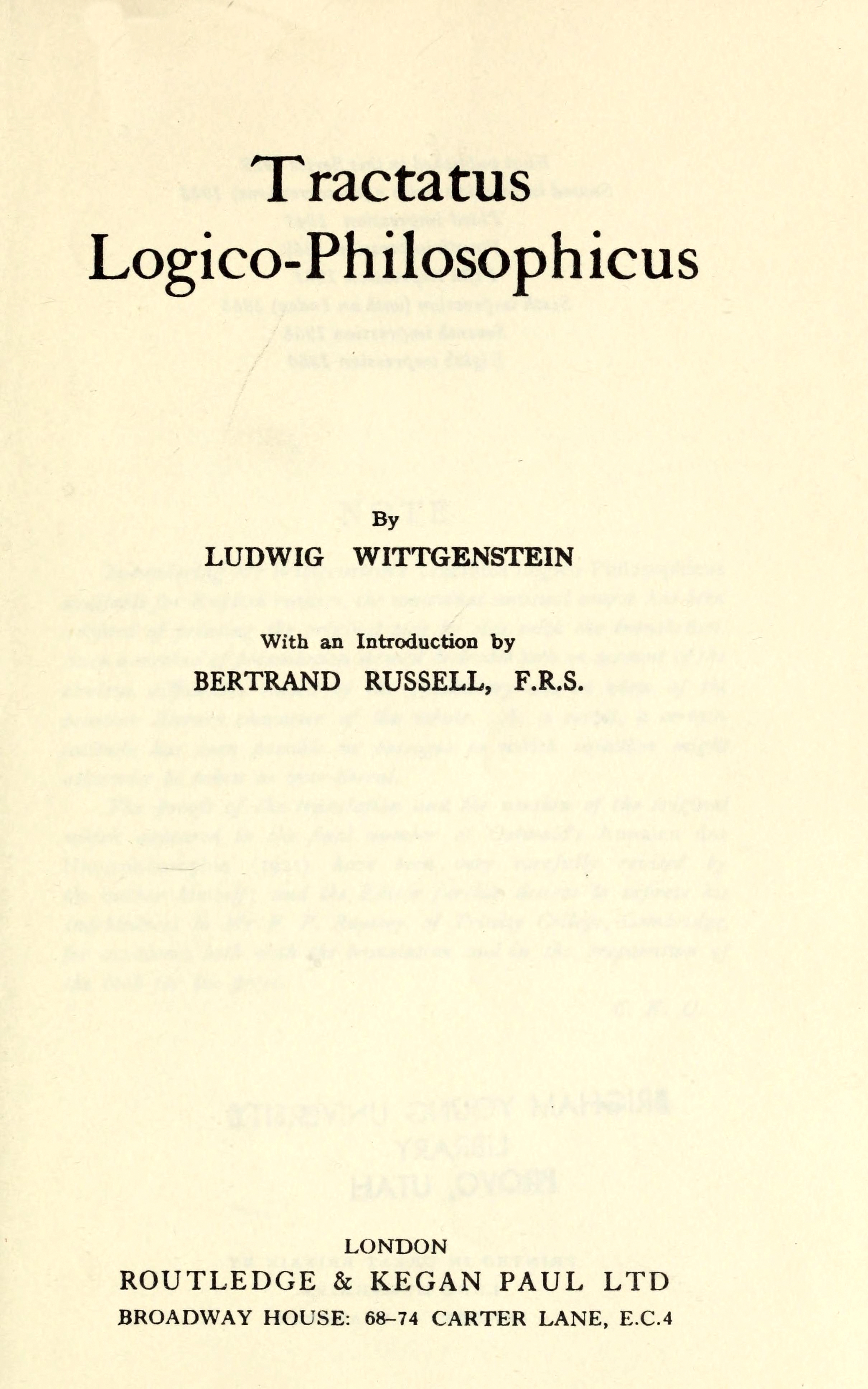
A book built like an argument tree
The Tractatus has seven main propositions, numbered 1 through 7. Every other remark is a sub-proposition, numbered by decimal extension of whichever proposition it comments on, so 1.1 elaborates 1, and 1.11 elaborates 1.1. It is meant to display the logical structure of the argument, each remark's place is fixed by what it depends on. Proposition 1 sets the thing in motion: "Die Welt ist alles, was der Fall ist," "The world is everything that is the case." Proposition 7, alone at the end with nothing beneath it, closes the book with its most famous line: "Wovon man nicht sprechen kann, darüber muss man schweigen," "Whereof one cannot speak, thereof one must be silent."
The picture theory
Wittgenstein's central idea is that a meaningful proposition is a picture of a possible state of affairs. A proposition and the fact which it depicts share a logical form, the way a map shares a structural form with the terrain it represents, without needing to resemble it. Where the objects named stand in the arrangement the proposition depicts, the proposition is true; where they do not, it is false. A picture cannot also depict its own form of depiction, since doing so would mean standing outside the picture to compare it with what it shows. Logical form is therefore something a proposition shows, automatically, rather than something it can additionally state.
Proposition 1.1 explains the metaphysics that this implies: "The world is the totality of facts, not of things." An inventory of every object would not describe the world, because objects alone settle nothing; only their standing in particular configurations does. The world decomposes into simple, independent atomic facts, and elementary propositions are their linguistic counterpart, with each one true when the configuration it pictures actually obtains. Every more complex proposition is, on this view, a truth-function of elementary ones, its truth value fixed by theirs. Wittgenstein calls this "logical atomism," extending into metaphysics a logical structure Frege and Russell had already built for the foundations of mathematics.
The book's one original technical contribution sits alongside this: Wittgenstein worked out, systematically, how the truth value of any complex proposition is fixed by the truth values of its parts, laid out in what is now called a truth table (an innovation from the same period usually credited jointly to him and the logician Emil Post). He then showed that a single operation, joint negation ("neither p nor q," equivalent to NOR), is powerful enough on its own to generate every other truth-function there is, echoing Henry Sheffer's near-identical discovery a few years earlier.
Saying and showing
Some things can be said: stated in a proposition that pictures a state of affairs, true or false depending on whether that state of affairs obtains. Other things can only be shown, displayed by the form of a proposition or the world, without being sayable as a further proposition alongside the ones doing the picturing. Logical form is the clearest case as it shows itself in the fact that a proposition succeeds in picturing anything at all, but cannot be stated as further content within any proposition, since doing so would require a further proposition standing outside logic to describe it.
This is where the Tractatus places ethics, aesthetics, and what Wittgenstein calls "das Mystische," the mystical. They are not dismissed as nonsense, however. Proposition 6.421 states: "Ethics and aesthetics are one." Both are shown, if they are disclosed at all, and neither is stateable as a further fact about how the world happens to be arranged.
Throwing away the ladder
Proposition 6.54 makes an interesting statement with no parallel elsewhere in philosophy. Wittgenstein states, of his own book, that its propositions are, judged by the very criteria the book has just spent six main propositions establishing, strictly nonsensical. They have been trying to say things, about logical form, about the limits of language, that the book's own theory holds cannot be said meaningfully by any proposition at all. The Tractatus is not exempt from its own verdict; it is, on its own terms, an extended catalogue of nonsense.
Wittgenstein's image for what to do with this is a ladder: a reader who understands him will eventually recognise the propositions as nonsensical, having used them as steps to climb beyond them, and must "throw away the ladder after he has climbed up it." What this leaves behind is an unsettled disagreement among his readers. One tradition treats the ladder as pointing toward real but strictly ineffable truths, gestured at by the nonsense the book tells its reader to discard. A newer reading, associated with Cora Diamond and James Conant, argues there is no such content behind the nonsense: it is plain nonsense, and treating it as gesturing at unsayable truths is the mistake the book is designed to cure. Whereof one cannot speak, thereof one must be silent.
Reception, and the author's own repudiation
The Vienna Circle read the Tractatus as support for their own verificationist programme, that a meaningful proposition must be either empirically verifiable or a logical truth, and that everything else, metaphysics and value-talk included, is not false but meaningless. This fastened onto half the book, the half about what falls outside meaningful discourse, while largely passing over the other half, in which Wittgenstein treats the unsayable, ethics and the mystical above all, as the most important thing the book gestures toward. He pushed back against the misreading, but it was already carrying his logical formalism, via A. J. Ayer's popularising Language, Truth and Logic, to an audience that came to associate his name with a programme he thought had inverted his own priorities.
Wittgenstein himself came to regard the picture theory as mistaken, and spent the rest of his working life building something close to its opposite, published posthumously as the Philosophical Investigations. Meaning, on that later view, is constituted by use, by how a word functions within a "language game," rather than by a proposition sharing logical form with a fact it pictures.
Discussion