Radio-isotopes in Fusion-Fission Hybrid Reactors
A report from Practical Physics III on activation and shielding studies supporting hybrid (fusion–fission) blanket design, combining a fast-neutron generator, activation foils, HPGe gamma spectroscopy, and a bench β-attenuation test.
What it covers
Fusion-fission hybrids couple a 14.1 MeV D–T fusion neutron source to a subcritical fission blanket to multiply source neutrons, breed fuel, and transmute actinides while keeping the safety margin of subcriticality. This report examines several of the design considerations that follow from that setup: the role of moderators versus multipliers in blanket design, activation of structural material (with particular attention to 52V half-life implications for maintenance and waste), activation-foil measurements (indium, gold) alongside absolute detector-efficiency modelling in LabSOCS, and shielding strategy for the mixed neutron–gamma fields characteristic of hybrids.
Headline results
- Gold foils irradiated in water and carbon moderators gave a thermal-flux ratio R = φth(water)/φth(carbon) = 4.95 ± 1.13, indicating a higher inferred thermal flux in water for the tested geometry.
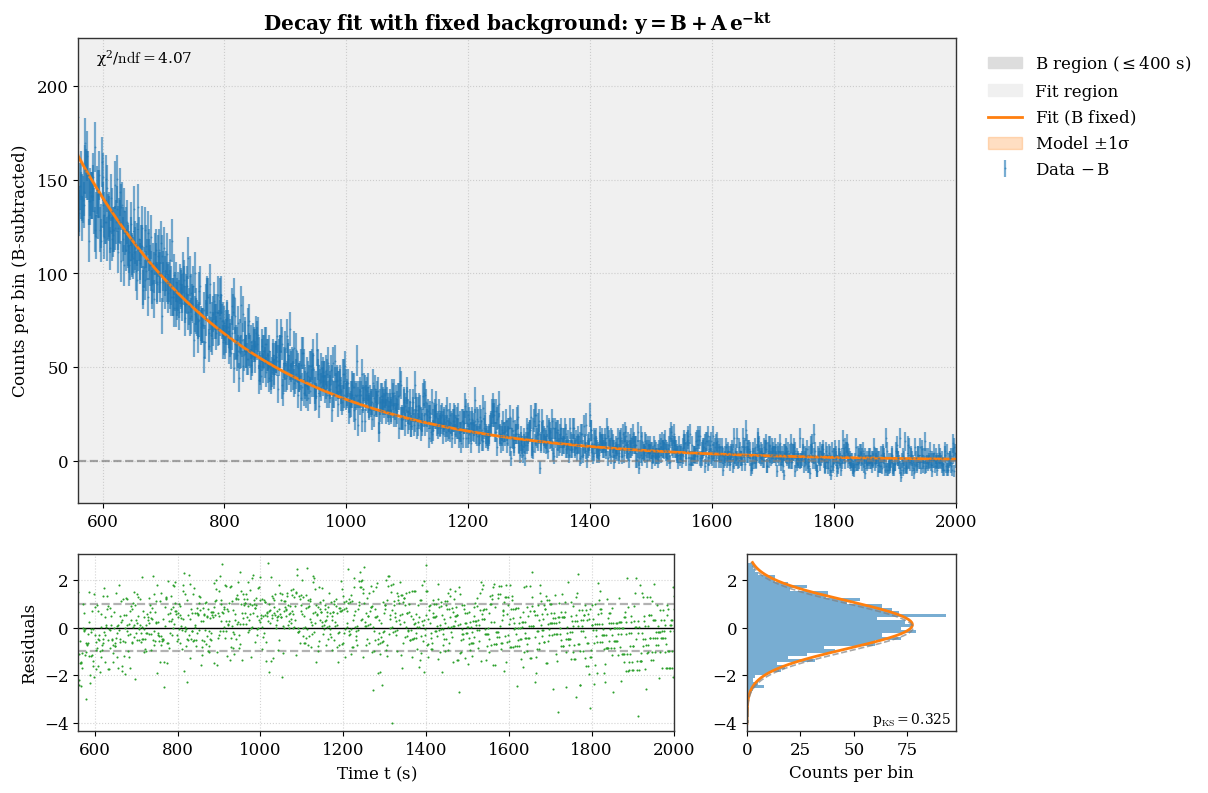
- Vanadium activation yielded a fitted half-life T1/2(52V) = 190.2 ± 1.5 s (3.169 ± 0.025 min), 15.3% below the NuDat3 reference value, with the plausible systematics discussed in the report.
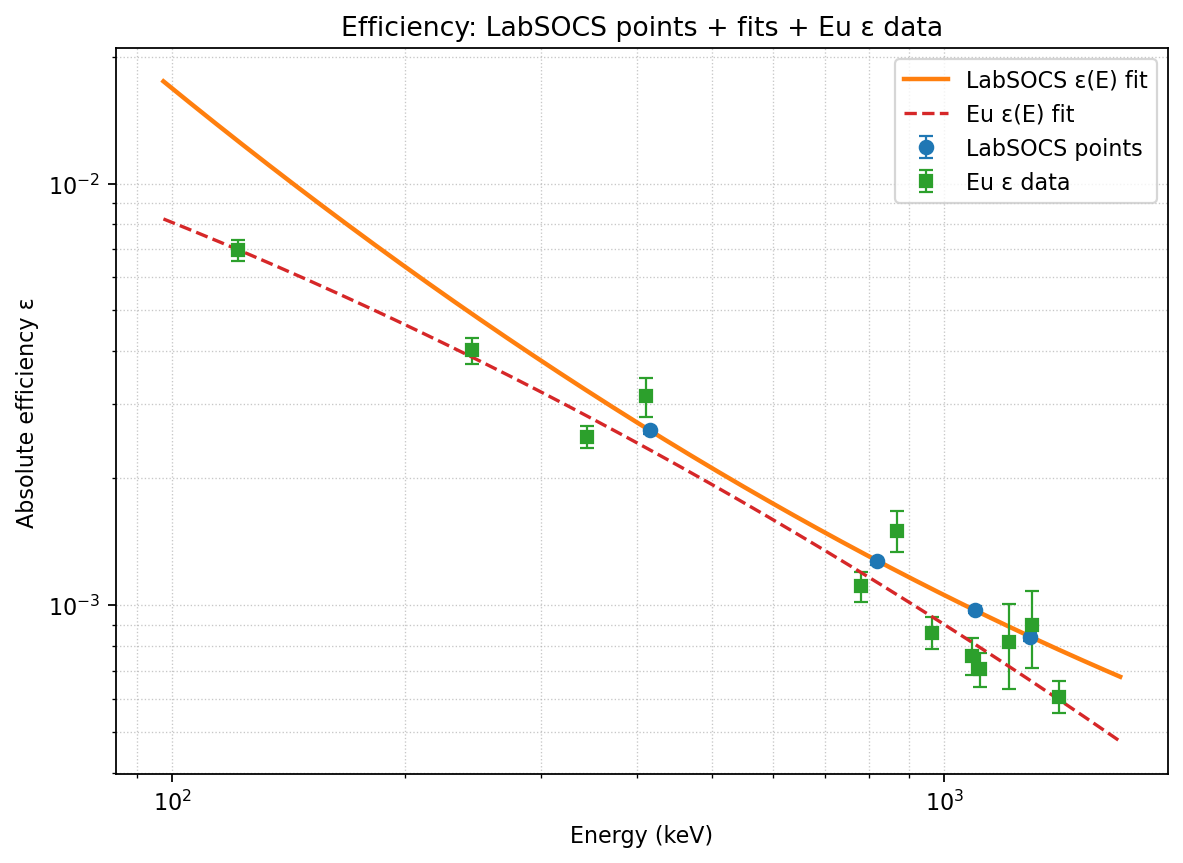
- Detector full-energy-peak efficiencies were modelled in LabSOCS and validated independently using a six-peak europium source, with decay correction applied from a known reference date and T1/2(152Eu) = 13.517 y.
- A bench β-attenuation test in aluminium supports a layered shield concept (low-Z / hydrogenous / borated / high-Z / concrete), informing moderator placement, tritium-breeding-ratio margins, shielding, and maintenance windows in hybrid designs.
Discussion