Dalí’s Scientific Influences
Salvador Dalí has been seen to play the part of the irrational genius, but a lot of his surrealist imagery may have come from a very deliberate and scientific place. A National Gallery of Victoria resource notes that he described himself in 1935 as “a fish swimming between ‘the cold water of art and the warm water of science’.”
His changing use of symbols and artistic choices can therefore be compared to the changing state of the scientific landscape in the twentieth century. The subconscious realm that he so often made use of gave way to melting clocks, quantisation of matter and the non-Euclidean geometry of strange topological spaces.
What makes Dalí especially interesting is that he used science as a permission slip to rebuild reality. He took influence from scientific theory to build strange and mystical realities.
Freud and the inner reality
Dalí’s first great scientific obsession was psychology, specifically Sigmund Freud’s writing on dreams and the unconscious. Surrealism as a movement was already heavily inspired by Freud and many surrealists practiced automatism (a practice of writing or drawing without thought). Dalí staged his own mind as an experiment, trying to generate images through what he called the “paranoiac-critical” approach, a method of producing meanings by cultivating associations and double readings.
In 1938, after repeated attempts, Dalí finally met Freud in London. The meeting was arranged through Stefan Zweig, with Dalí’s patron Edward James present, and Dalí arrived hoping to use his painting The Metamorphosis of Narcissus as a bridge into Freud’s theory of narcissism and his own paranoiac-critical ideas (Fig. 1).
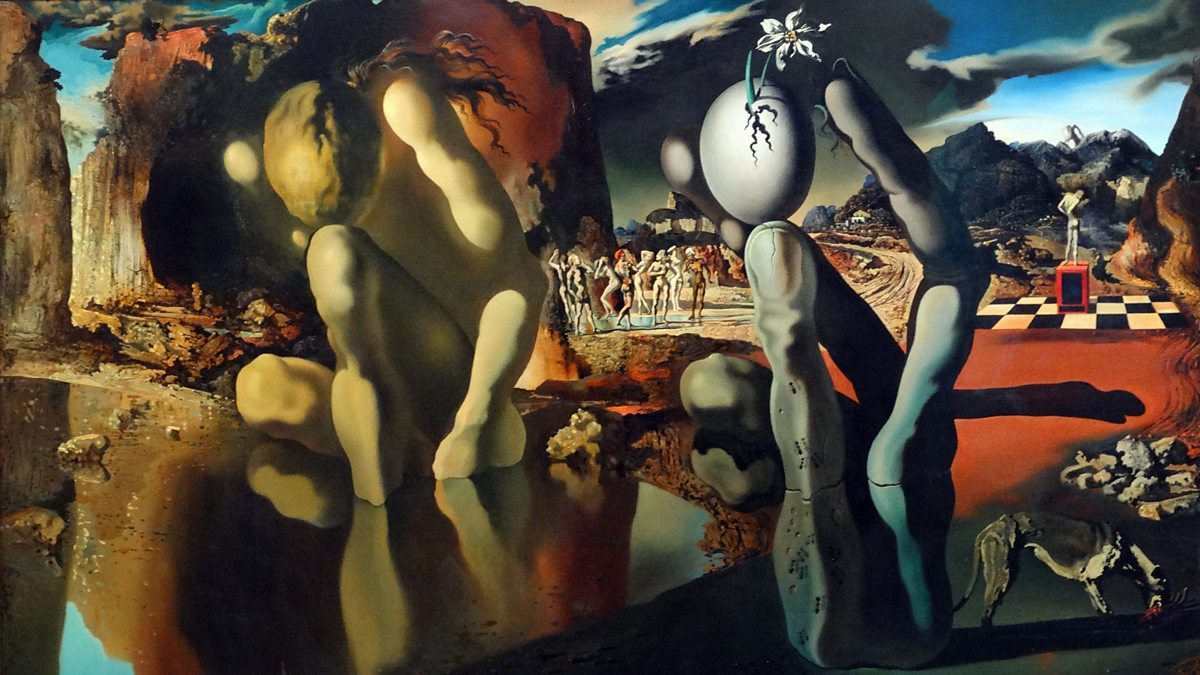
Even Dalí’s public theatrics sometimes carried a “scientific” meaning. The Dalí Foundation notes that a diver figure at the entrance to the Dalí Theatre-Museum commemorates his 1936 talk in London, delivered in a diving suit as a symbol of plunging into the depths of the unconscious, straight out of Freudian imagery [6].
Freud gave Dalí a model of hidden causation stating, ‘the surface of reality is only the symptom, and the real action happens underneath’. That is exactly how many early Dalí paintings are interpreted. A face is also a landscape. A still life is also a desire. A single scene fractures into multiple readings and interpretations.
Einstein and the ‘melting clocks’
Dalí’s most famous painting, The Persistence of Memory (1931), has often been connected to a broader cultural fascination with time, and the NGV resource suggests it may have been influenced by Einstein’s theories of relativity (Fig. 2).
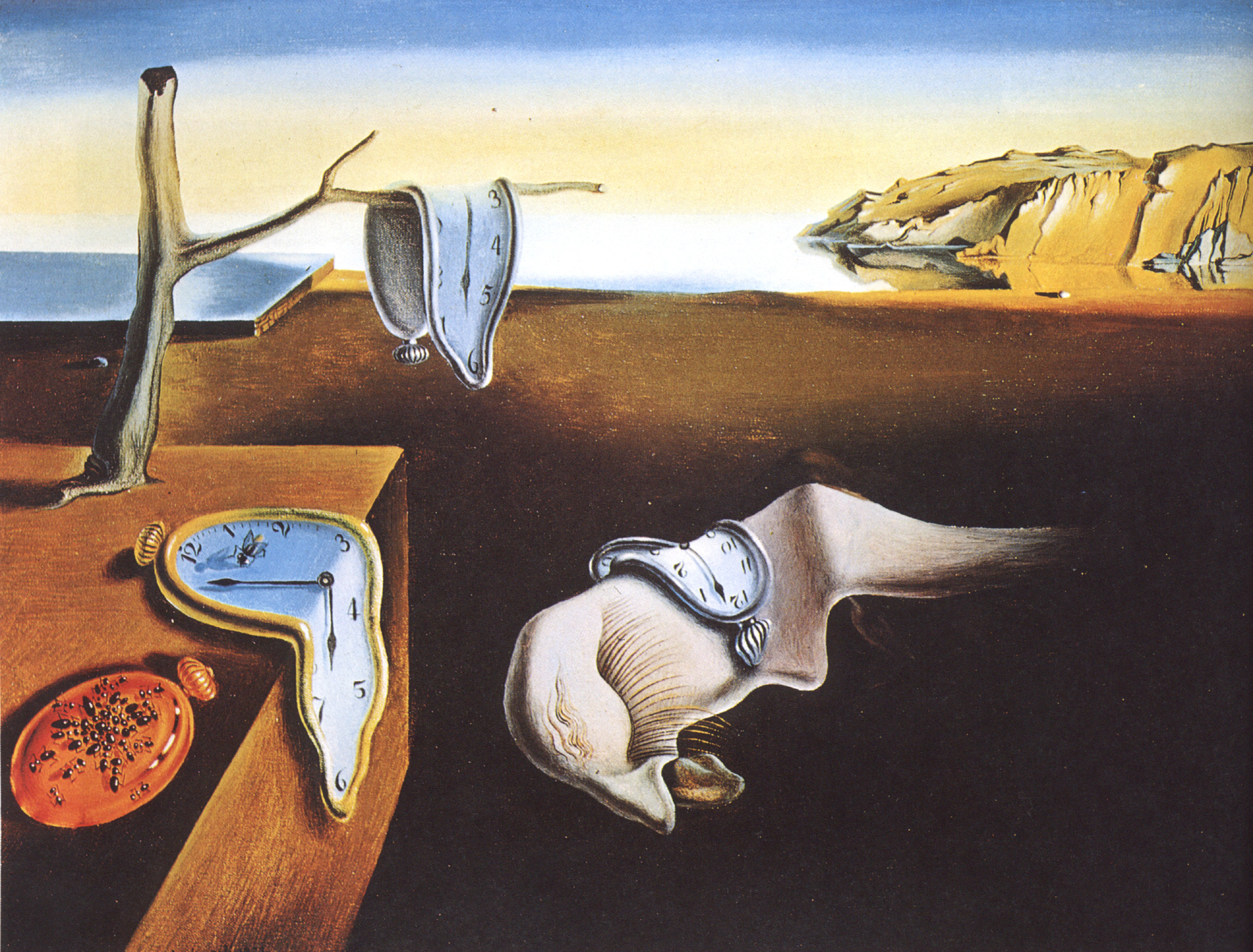
Whether or not Dalí was “illustrating relativity” in any strict sense, Einstein’s fame mattered because it made the dissolution of rigid time known to the public.
Later, Dalí keeps returning to that time theme, but he treats it as something history itself has damaged. In discussions of The Disintegration of the Persistence of Memory (1952), the NGV material frames the change as a shift in explanatory authority: where psychoanalysis once explained the universe’s mysteries, now quantum mechanics does. The clocks survive, but the world around them breaks into pieces (Fig. 3).
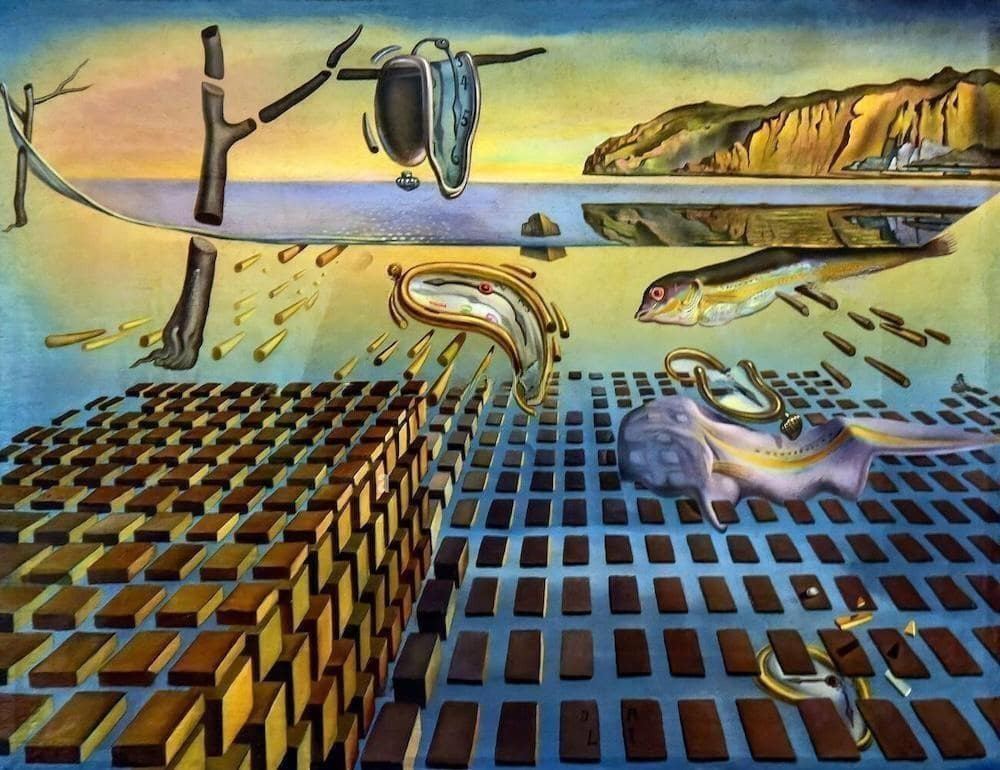
The melting clocks can be discussed in terms of the action of melting. They did not break or fall apart but instead are pictured as fluid. This is metaphoric of Einstein’s theory of special relativity where time did not break in the fashion that some of the public saw but instead becomes more fluid than rigid. It’s interesting that Dalí chose to represent these melting clocks in this way and not simply breaking.
Quantum theory and the atomic metaphor
The Dalí Foundation explicitly notes that Dalí “deepened his interest in Planck’s quantum theory” around 1940 [2]. In the early 1930s, he was already quoting scientific thinkers to push against the supposed border between art and science. The NGV resource states that in 1932–33 Dalí wrote The Tragic Myth of the Angelus by Millet and quoted quantum physicist Erwin Schrödinger in the process. This matters because it shows Dalí taking scientific language seriously, not just borrowing it for aesthetic purposes.
The NGV resource describes how, after the atomic bomb in August 1945, Dalí became captivated by nuclear physics and began painting his imagery as if it were disintegrating into atoms floating in space. That stylistic shift, the “corpuscular” look where objects separate but remain suspended, becomes one of his signatures in the 1950s [1].
A demonstration of this “atomising” approach is The Disintegration of the Persistence of Memory (1952 to 54), where Dalí revisits his famed 1931 scene and breaks its solid forms into discrete, floating blocks and fragments [1].
Dalí pushed this fascination into manifesto form. In 1958, he wrote an “Anti-material Manifesto” for a New York exhibition catalogue, declaring that he wanted to “transport” his works into anti-matter and citing Werner Heisenberg’s equations, even joking that he would now admire Heisenberg. The NGV resource quotes: “Today the exterior world, that of physics, has transcended the one of psychology… My father today is Dr Heisenberg.” [1]
The Moderna Museet timeline notes that in 1958 he ordered a 12 metre baguette to illustrate Heisenberg’s uncertainty principle during a lecture in Paris [5].
Nuclear mysticism
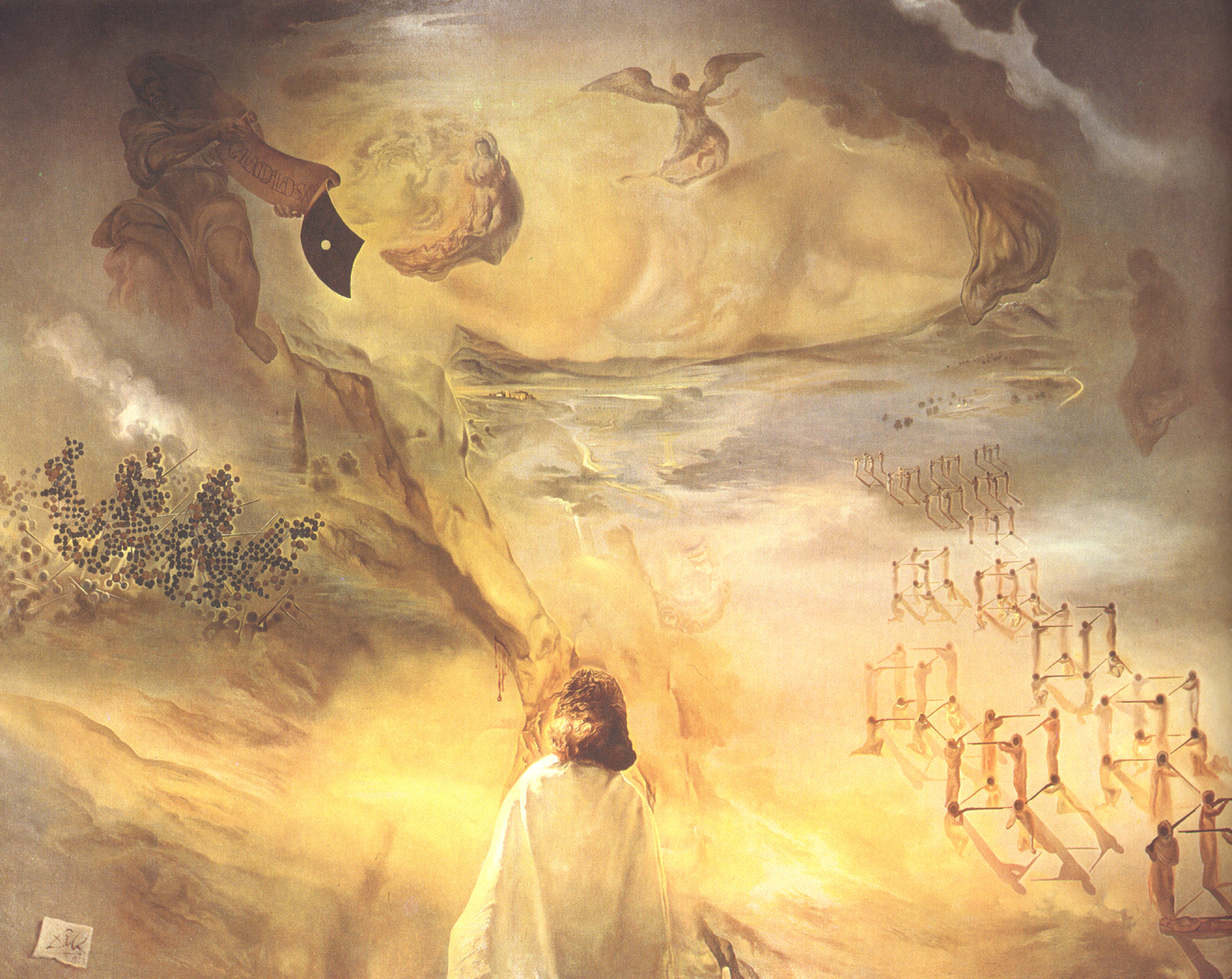
The NGV resource describes how this post-1945 period, often called “Nuclear Mysticism,” coincided with Dalí’s return to the Catholic Church, and that many paintings use ideas from modern science to reinterpret and rationalise Christian belief. That is why works like Galatea of the Spheres (1952) can feel both scientific and devotional (Fig. 4). The face becomes a constellation of floating “particles,” as if the human body is made of quantised, luminous units.
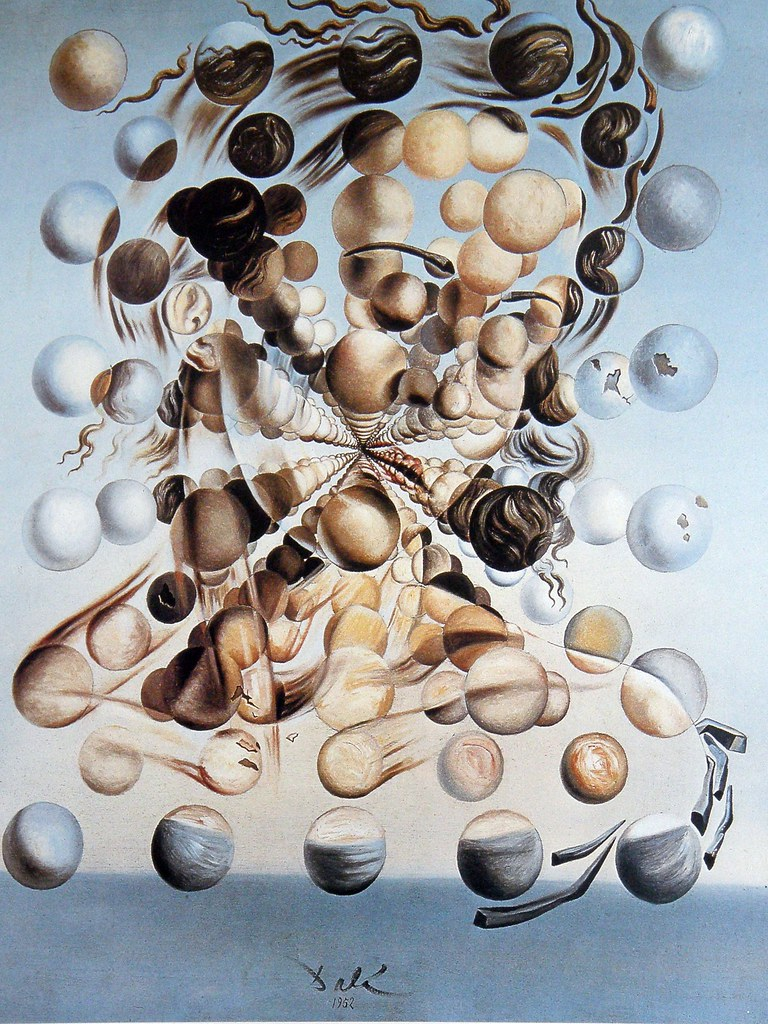
The NGV resource discusses Dalí’s repeated use of rhinoceros horns as bomb-like shapes and explains the horn as a natural form developing along a logarithmic spiral, which Dalí read as a symbol of underlying order. Some may argue that he finds a structure that looks mathematical, then treats it as evidence that reality has a hidden architecture [1].
Mathematics and higher dimensions
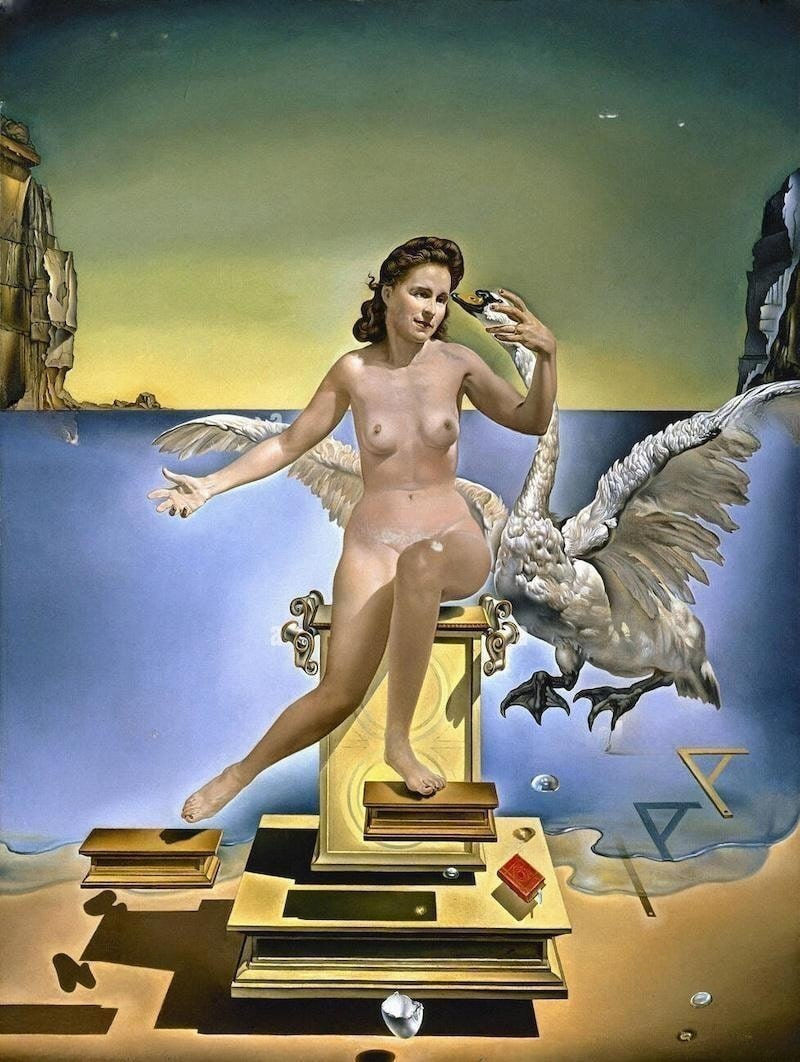
The Dalí Foundation reports that in 1949 he avidly studied Luca Pacioli’s Divina proportione, and that same year he painted Leda Atomica, a work that displays extensive mathematical structure (Fig. 5).
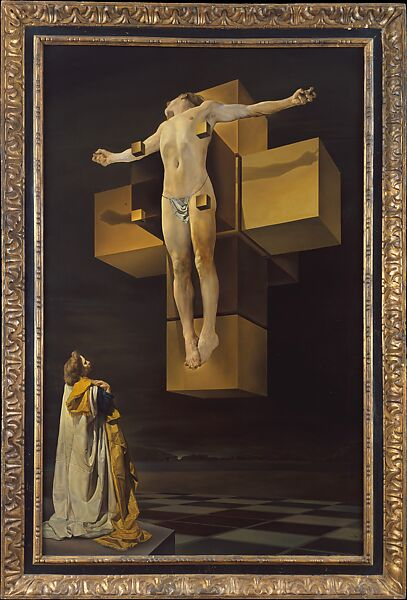
In Crucifixion (Corpus Hypercubus) (1954), the cross becomes a hypercube net, a symbol that implies a higher-dimensional object unfolded into our three-dimensional world (Fig. 6). Even without doing the geometry, the viewer will surely feel the intent: spiritual realities may be casting a shadow onto our reality (think the four-dimensional cube cast to a three-dimensional net cast to a two-dimensional painting). This is still nuclear mysticism, but in the form of dimensional play instead of particles.
DNA
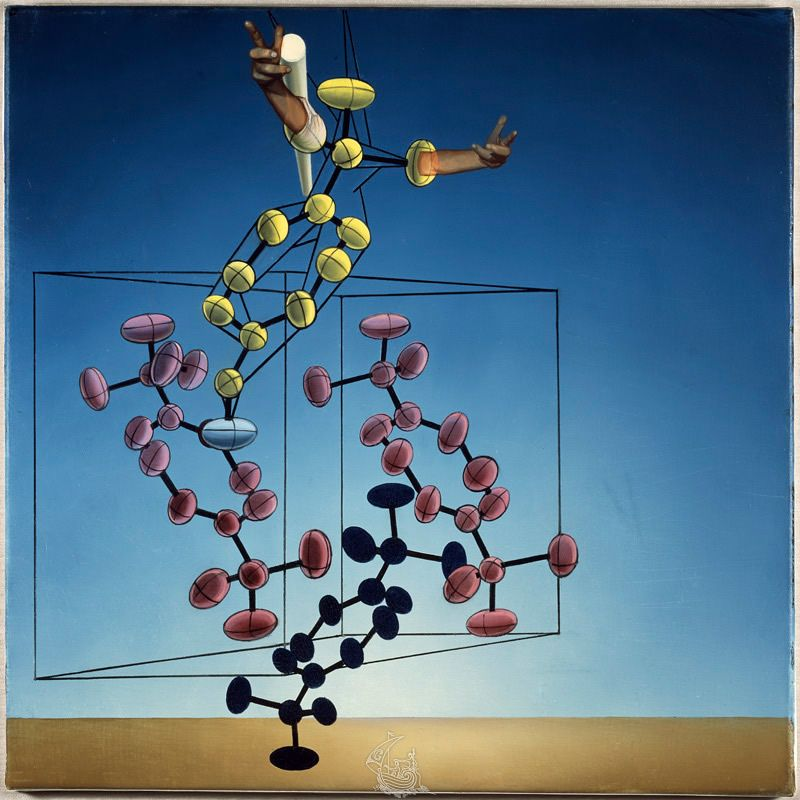
Dalí’s scientific interests did not stop at physics. The Dalí Foundation notes that from 1962 to 1978 his work was “truly influenced by the impact of science,” with a major focus on genetics and, more specifically, DNA and its structure. The most apparent evidence is the painting titled Galacidalacidesoxyribonucleicacid (1963), whose name combines “Gala” and “deoxyribonucleic acid” (Fig. 7).
A Dalí Foundation exhibition page on his stereoscopic work includes a piece titled The Structure of DNA, made as a stereoscopic work around 1975–76 providing another homage to the scientific work conducted by Crick, Watson and Franklin (Fig. 8).
Optics, stereoscopy, and holography
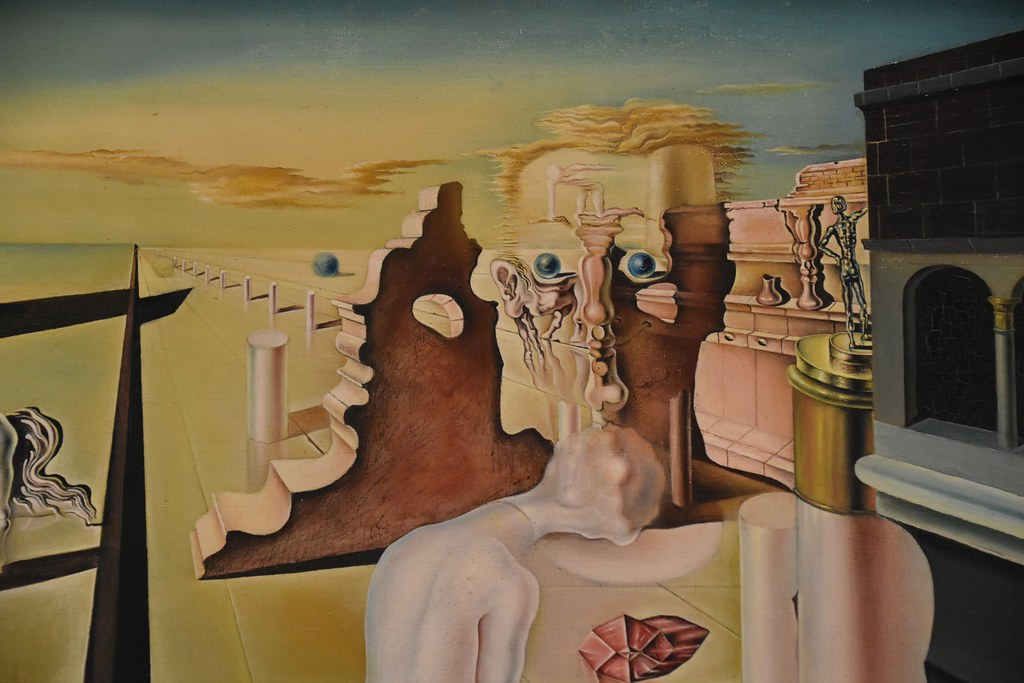
The Dalí Foundation notes that the 1930s were marked by his interest in dual images and optical illusions, beginning with The Invisible Man (1929), and continuing through several works built around double readings (Fig. 9). This early fascination later becomes more technical. The Foundation reports that by the mid-1960s Dalí’s interest in holography and 3D art were in full swing. He studied stereoscopic effects and used tools like a Fresnel lens to assemble dual images.
The Foundation describes how, after Denis Gabor received the Nobel Prize in 1971, Dalí pursued holography and in 1972 hosted a hologram exhibition at the Knoedler Gallery in New York, presenting a hologram titled Holos! Holos! Velázquez! Gabor! The NGV resource similarly notes that Dalí was among the first artists to work with holography as a new medium [1].
His stereoscopic paintings try to describe the idea that reality is not independent, but it is constructed in the brain. The Dalí Foundation’s stereoscopy page explains that Dalí shifted paired images, so the viewer’s mind forms a 3D composition, and it quotes his collaborator Antoni Pitxot on Dalí’s fascination with escaping the limits of optical experiments to create new illusions. Dalí uses science as a technique here and not just as a subject matter [7].
Catastrophe theory and topology
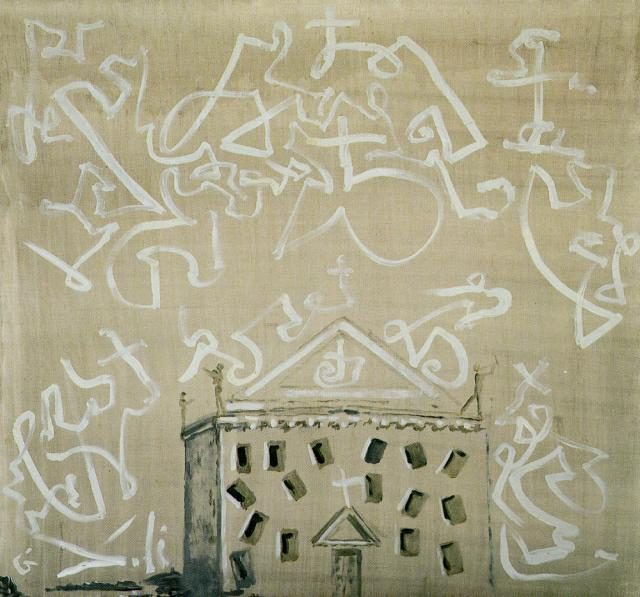
A Dalí Foundation overview states that from the 1980s to the end of his life he focused on René Thom’s catastrophe theory, producing works such as Treatise of Catastropheiform Writing (1982) (Fig. 10) and Topological Abduction of Europe. Homage to René Thom (1983) (Fig. 11). The same text describes a 1985 symposium at the Dalí Theatre-Museum titled “Culture and science: determinism and freedom,” organised with the Physics Faculty of the University of Barcelona, and notes that Dalí followed the sessions attentively and even weighed in on debates involving Thom and Ilya Prigogine.
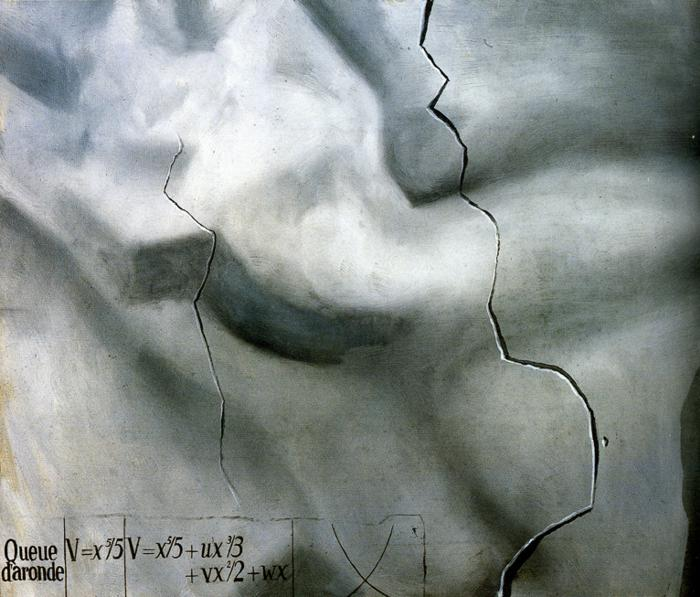
Dalí began with Freud, a theory of hidden forces inside the self. He ends with catastrophe theory, a theory of how tiny changes in conditions can produce abrupt shifts in form. The scientific subjects he has followed have transformed drastically but his desire to marry science and art has remained throughout his years.
Concluding thoughts
Freud offered a new reality born of the subconscious. Einstein offered an non-Euclidean and elastic view of time and space. Quantum theory offered uncertainty, particles, anti-matter, and the idea that the act of measurement changes what you see. Nuclear physics offered the terrifying beauty and deadly strength of a tiny atom. DNA offered the possibility that life is written. Optics and holography offered proof that reality is constructed in the mind. Catastrophe theory offered a model of complexity. All of these tied into the beauty of Dalí’s God’s creation.
Through it all, Dalí kept very consistent. He would take what science claimed about reality and turned it into a painted and mysterious landscape.
References
- National Gallery of Victoria, Dalí and Science (education resource PDF), 2009.
- Fundació Gala-Salvador Dalí (Carme Ruiz), “Salvador Dalí and science” (timeline of interests).
- Fundació Gala-Salvador Dalí (Carme Ruiz), “Salvador Dalí and science. Beyond a mere curiosity.”
- Freud Museum London, “Freud, Dalí and the Metamorphosis of Narcissus” (meeting context and aims).
- Moderna Museet, “Salvador Dalí” (biographical timeline, including 1958 baguette anecdote).
- Carme Ruiz González, “The Largest Surrealist Object in the World” (diver mannequin as memento of the 1936 diving-suit lecture).
- Fundació Gala-Salvador Dalí, “Dalí. Stereoscopic images. Painting in three dimensions” (includes The Structure of DNA, c. 1975–76).
Discussion