Report on Lucretius: Physics, Philosophy, Poetic Form, and Influences
Titus Lucretius Carus is best known for his philosophical poem De Rerum Natura ("On the Nature of Things"), which provides an in-depth explanation of the natural world from the standpoint of Epicurean philosophy. His ideas, though revolutionary, were heavily criticized at the time.
Lucretius’s work delves into atomic theory, the rejection of divine causality, and the mechanistic workings of the cosmos, challenging religious and mythological interpretations of the world. His philosophy connects natural law and materialism to ethics, psychology, and cosmology, and laid the foundation for later scientific theories.
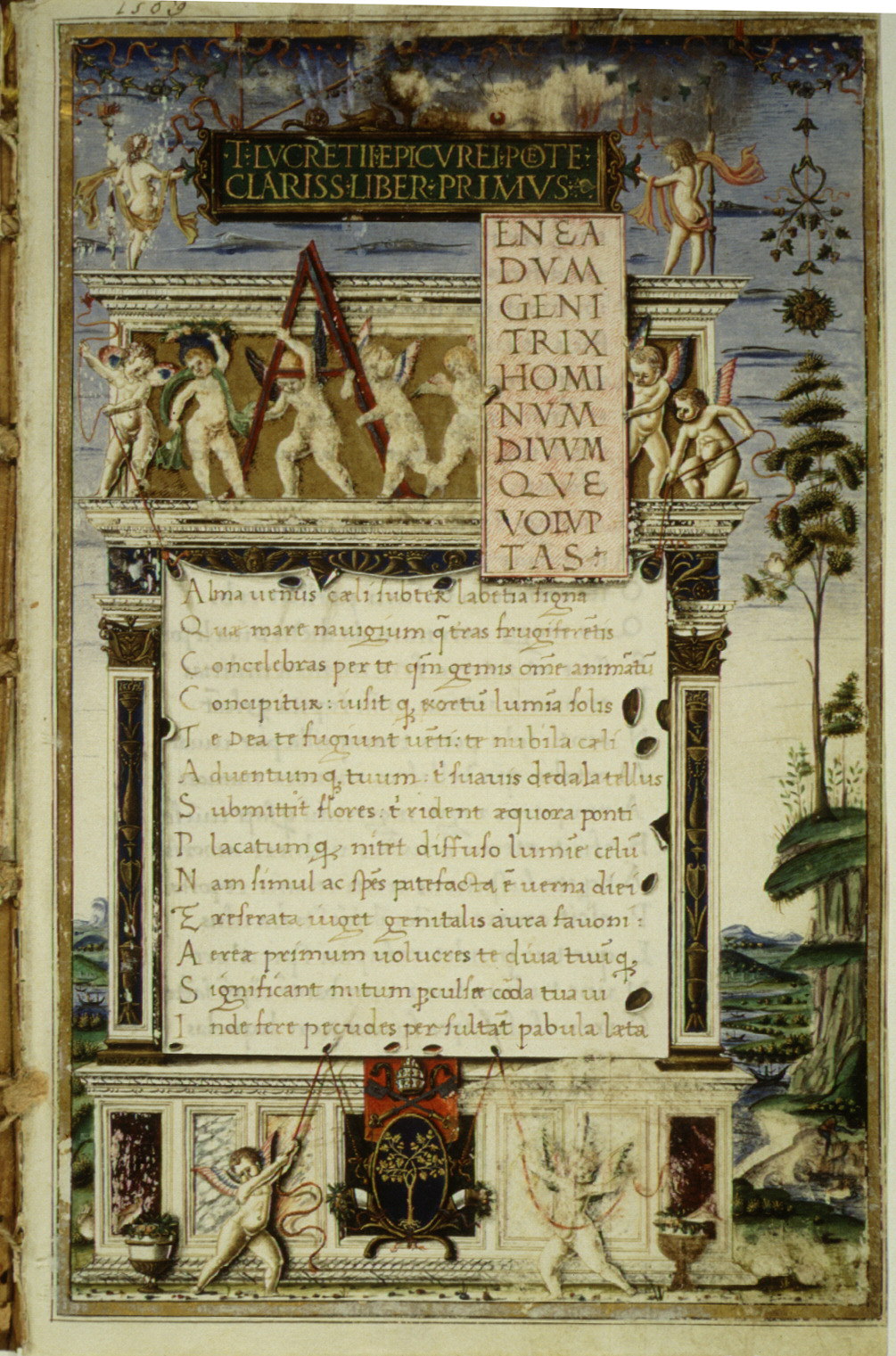
What makes Lucretius especially fascinating is his ability to construct a vision of the universe through rationalism and empirical observation, using the latest scientific ideas of his time to explore deeper metaphysical questions.
Lucretius's Physics and Philosophical Implications
At the core of Lucretius’s physical philosophy is the atomic theory of nature. He argued that everything, from inanimate objects to living beings, is made of indivisible particles called atoms. These atoms are in constant motion and interact through the forces of attraction and repulsion, which govern matter's structure and behavior.
His materialistic worldview, which denied divine intervention, had profound implications for religion, ethics, and the traditional Roman understanding of the cosmos. Lucretius argued that everything operates according to natural laws, not through divine causality. His rejection of gods intervening in the world marked him as an early proponent of atheism, although this term was not yet defined in his time.
Lucretius on Democritus and Epicurus
Lucretius was heavily influenced by the philosophies of Democritus and Epicurus. Democritus’s atomic theory laid the foundation for Lucretius’s views, though Lucretius further developed the implications of atomism, especially in relation to the soul and human experience.
Epicurus, an important precursor to Lucretius, connected atomic theory with the pursuit of human happiness. He advocated for a life free of fear and pain, grounded in rational understanding and self-control. Lucretius expanded upon this by applying atomism not just to ethics but to all aspects of nature, from disease to death, making his worldview fully naturalistic and without divine purpose.
Implications of Atomic Physics
Lucretius’s depiction of atoms can be seen as an early version of modern atomic theory. He argued that atoms, though indivisible, are in constant motion, with different shapes and sizes, determining the properties of matter. This idea aligns with the early concepts of particle physics, where atomic interactions define the structure of the universe.
One of Lucretius's advanced ideas is the concept of "swerve" (clinamen), which allows for free will in a deterministic universe. This swerve, like quantum indeterminacy, suggests that atoms do not always follow predictable paths, creating room for new combinations and causal events. It is an early idea akin to what we now understand as quantum mechanics and the unpredictability of particles at the atomic level.
Philosophical Rejection of Religion
Lucretius argued that the natural world operates through mechanical laws, not divine will. He rejected the belief in an afterlife, claiming that death is the dissolution of atoms and that the soul dies with the body. This rejection of immortality and divine intervention marked a radical departure from religious traditions.
Without the fear of divine punishment or hope for eternal life, Lucretius believed humans could live more peaceful, rational lives. His ethics emphasized inner peace through the understanding of natural law and the elimination of irrational fears.
Dactylic Hexameter
One striking feature of De Rerum Natura is its use of dactylic hexameter, the meter associated with epic poetry. Lucretius’s choice to use this grand, heroic form to explore natural philosophy was a deliberate decision to elevate his ideas to the level of classical epics, even though his work explored scientific and philosophical concepts rather than mythological themes.
Evolution in Lucretius's Philosophy
Though Lucretius did not have access to modern evolutionary theory, his materialistic description of the world laid the groundwork for ideas later developed in evolutionary biology. He argued that life forms arise through random atomic combinations and that natural processes drive the diversity of species. This idea, though not a formal theory of evolution, suggests an early understanding of natural selection and variation.
Water in Lucretius's Philosophy
Water plays a central role in Lucretius’s cosmology, serving as a key element in the cycles of nature. It is constantly transforming through different states—liquid, vapor, and solid—just as atoms are in motion, illustrating the ever-changing, dynamic nature of the universe.
Lucretius and the Psychology of Fear
Lucretius explored the psychological dimensions of fear and suffering, particularly the irrational fears stemming from religion and superstition. He argued that by understanding nature’s workings, humans could free themselves from these anxieties, achieving a life of tranquility and peace. This anticipation of later psychological theories, like cognitive behavioral therapy (CBT), shows his forward-thinking approach to the human mind.
Influence on Later Thinkers
Lucretius's materialism influenced later philosophers such as Baruch Spinoza and even Karl Marx. His rejection of divine intervention and natural law would become central to the Enlightenment and modern scientific thought. His ideas shaped the development of scientific theories and are considered a precursor to later materialist and atheistic movements.
Cosmology in Lucretius's Philosophy
Lucretius proposed an infinite and ever-changing universe composed of atoms. He emphasized the cosmos’s boundlessness, both in space and time, suggesting that it is in constant motion, governed not by divine will but by mechanical laws. This view anticipates modern cosmology and aligns with ideas of the infinite universe in astrophysics.
Epistemology in Lucretius's Philosophy
Lucretius believed that knowledge arises from the senses, which provide raw data that the mind processes through reason. He rejected supernatural explanations, emphasizing empirical observation and logical reasoning as the foundation of all knowledge. His naturalistic epistemology was ahead of its time, laying the groundwork for the scientific method and modern empirical inquiry.
Concluding Thoughts
Lucretius's *De Rerum Natura* presents a radical, materialistic view of the universe, grounded in atomic theory and natural law. His work anticipates many modern scientific principles, from atomic physics to quantum mechanics, and remains remarkably advanced in its treatment of free will, determinism, and human psychology. Through his blending of science, philosophy, and poetry, Lucretius continues to influence both intellectual and literary thought, offering timeless insights into the nature of existence.
References
- National Gallery of Victoria, Dalí and Science (education resource PDF), 2009.
- Fundació Gala-Salvador Dalí (Carme Ruiz), “Salvador Dalí and science” (timeline of interests).
- Fundació Gala-Salvador Dalí (Carme Ruiz), “Salvador Dalí and science. Beyond a mere curiosity.”
- Freud Museum London, “Freud, Dalí and the Metamorphosis of Narcissus” (meeting context and aims).
- Moderna Museet, “Salvador Dalí” (biographical timeline, including 1958 baguette anecdote).
- Carme Ruiz González, “The Largest Surrealist Object in the World” (diver mannequin as memento of the 1936 diving-suit lecture).
- Fundació Gala-Salvador Dalí, “Dalí. Stereoscopic images. Painting in three dimensions” (includes The Structure of DNA, c. 1975–76).
Discussion