Optimising a Plastic-Scintillator Cosmic-Ray Detector
A summer research placement working with a two-detector cosmic-ray telescope built from plastic scintillating fibres (BCF-12MC.25, 0.25 mm diameter, Saint-Gobain), reading out through a NIM electronics crate into coincidence logic. The core problem throughout was parameter optimisation: threshold voltage, discriminator width, and photomultiplier (PMT) voltage all trade off against each other in setting the count rate, the coincidence rate, and the noise floor, and no single one of them can be tuned in isolation.
The hardware
Data acquisition ran through a Nuclear Instrumentation Module (NIM) crate: a CAEN N1470 high-voltage supply for the PMTs (Hamamatsu H10580 tubes, ~6 kV rail voltage), a CAEN N625 fan-in/fan-out for distributing analogue signals, a CAEN N840 leading-edge discriminator for setting the voltage threshold, a CAEN 757 dual logic unit for AND/OR/NAND coincidence logic, a CAEN N415 dual scaler for counting, a CAEN N405 three-fold logic unit for background rejection (later swapped for a Philips Scientific 794 quad gate/delay generator when a module failed), and a CAEN N17B dual timer for generating adjustable-width gate pulses. Waveforms were checked on a Teledyne LeCroy HDO6014-MS oscilloscope (1 GHz, 2.5 GS/s).
Threshold voltage and discriminator width
The first optimisation problem was the discriminator threshold voltage: too low and the random (noise) count rate dominates, too high and genuine cosmic-ray events start getting discarded. Sweeping threshold voltage against random count rate and fitting several candidate models by chi-squared, the best fits landed at \( \chi^2/\text{ndf} \) between 3 and 4, giving a working threshold of \( 0.0085 \pm 0.0001~\text{V} \), corresponding to \( 0.0701 \pm 0.0027 \) random counts per second. Repeating the sweep across seven discriminator widths (100 ns to 100 μs) turned this into a genuinely multivariable problem, since random count rate, counts on each individual detector, and the coincidence rate all depend jointly on threshold voltage and discriminator width.
Modelling a 2-3 parameter surface
Several approaches were tried for fitting the resulting response surfaces: a simple linear plane (ax + by + c = z), a sigmoid model optimised by chi-squared, a small convolutional neural network (a single Conv1d layer feeding a linear output, trained for 10,000 epochs with a weighted-MSE loss to down-weight outliers), support-vector regression, and a random-forest regressor. The linear and early sigmoid fits were poor (\( \chi^2/\text{ndf} \) around 17 in the worst case), and a sharp, physically implausible peak in the fitted surface at very low threshold voltage was traced to electrical noise dominating that region, not a real feature of the count-rate response. The CNN and later random-forest models handled the joint dependence on threshold voltage and discriminator width considerably better, and the random-forest regressor was ultimately used to search for the operating point that maximised the count-to-noise ratio (CNR), not raw count rate.
Finding the optimal PMT voltage
With a working threshold/width regime established, the remaining free parameter was PMT high voltage, swept across 1200–1450 V. This stage was hampered by two genuine data-taking mistakes worth recording honestly: one dataset was invalidated by forgetting to update a second channel's voltage in step with the first, another by a coincidence gate silently configured as OR instead of AND. Both were caught from inconsistent downstream model behaviour and the affected data retaken. The corrected 1200–1450 V PMT sweep pointed to optimal PMT voltages of around 1325–1350 V, taken as the inflection point furthest right that still minimises noise without cutting into genuine coincident events.
As a sanity check, the equilibrium cosmic-ray count rate measured through the optimised chain (~0.1 events/s) was compared against the expected flux for a 16 cm² scintillator using the standard sea-level muon flux, giving an expected rate of about 0.25 events/s. The discrepancy is likely a mix of attenuation in the detector stack and the threshold still being set slightly conservatively.
Building the detectors
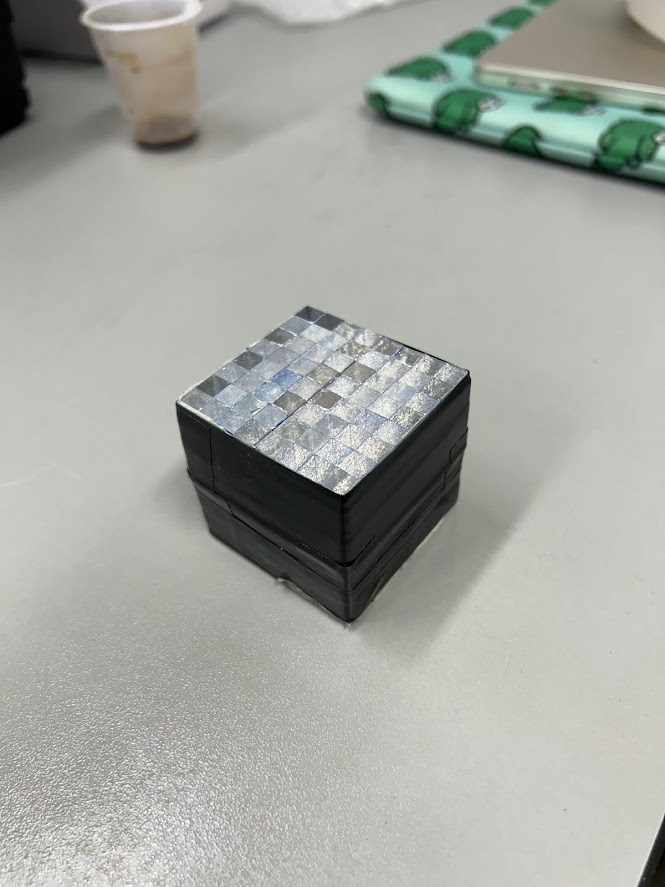
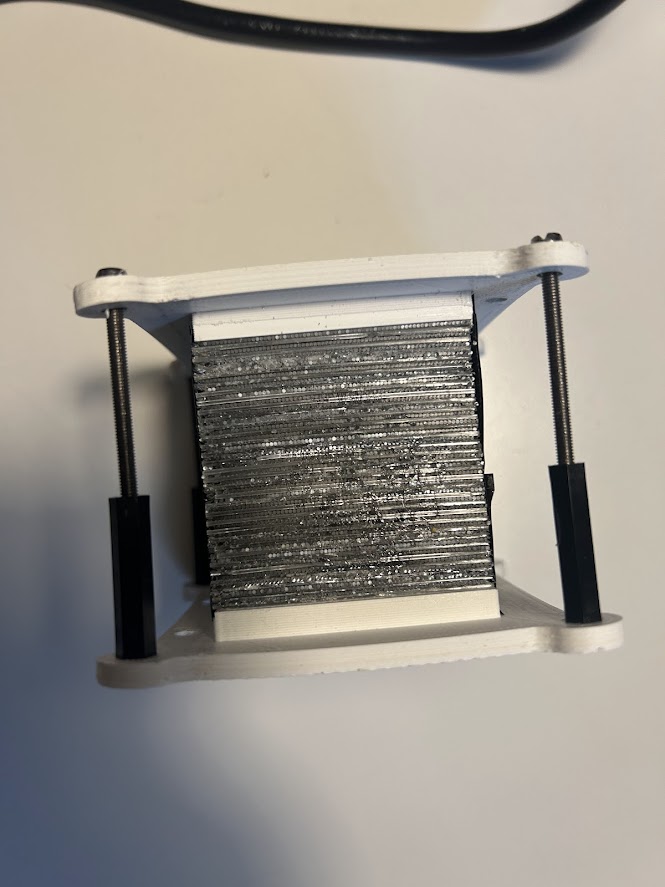
Alongside the electronics work, I was shown how the 2D scintillating-fibre matrix detectors themselves are built: fibres are wound flat and under tension on a purpose-built winding jig (nicknamed "Arianna"), a mixture of EJ-500 optical cement resin and hardener is used to bond them into a solid block, the assembly is left spinning for 24 hours to cure evenly, and the cured block is then cut into the finished detector segments shown above.
This placement is now complete; the write-up above covers the optimisation work as it concluded.
Discussion